
This English version may have been machine-generated from the Chinese original and may not convey the original meaning accurately.
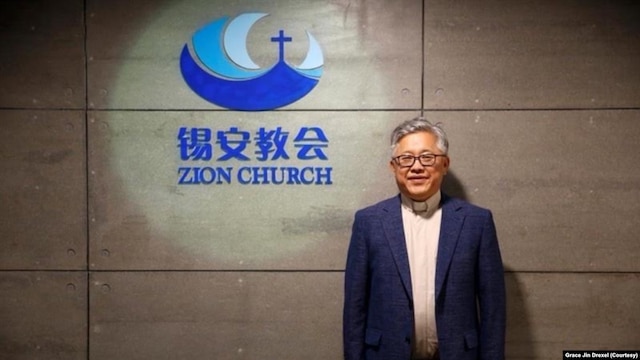
It was reported that Zion Church pastor Kim Myung-il was released after nearly nine months in detention and arrived in the United States to reunite with his family. This should have been reassuring news—a citizen who had endured prolonged detention because of his faith had finally regained his freedom. Yet while expressing their gratitude, the family and human rights organizations specifically reminded the public that several other Zion Church members remain imprisoned. That reminder precisely highlights what is truly so troubling about this “good news.”
Zion Church is not an isolated case. In recent years, unregistered house churches in China that have not joined the official “Three-Self” system have repeatedly faced crackdowns: gatherings forcibly disbanded, venues sealed, and believers summoned for questioning or detained. These have long been open secrets. Kim Myung-il’s release seems less like the normal result of judicial proceedings than an instance of “case-by-case handling” under external pressure—according to reports, his family explicitly attributed it to the mediation efforts of a foreign government. This alone is worth serious reflection: if a citizen’s freedom can be restored only through political pressure from abroad, rather than through due process and an independent trial under the law of his own country, what does that say?
The answer is not complicated: when a country’s judicial system cannot operate independently of the ruling party, and when decisions to arrest, detain, or release someone can change at any moment for diplomatic considerations, then so-called “rule of law” is merely an ornament of power. Freedom of religion and personal liberty are not rights that automatically become reality simply because they are written into constitutional provisions. They require an independent judiciary, transparent procedures, and accountable law-enforcement agencies to safeguard them in practice. Without the separation of powers and judicial independence, individuals’ fates will always hang on the whim of those in power—someone may be released today because of diplomatic necessity, and arrested tomorrow for the sake of “maintaining stability.”
More troubling still, this kind of case-by-case “resolution” precisely conceals the systemic problem. Once a pastor is released, the media spotlight shifts elsewhere, while the church members who remain detained and the surveillance and repression mechanisms that remain in place are rarely questioned further. Freedom of religion should not be a diplomatic bargaining chip subject to negotiation; it should be a fundamental right inherent to every citizen and not something to be exchanged for political concessions.
The genuine solution has never been to pin hopes on the “grace” of individual leaders or the “results” of a particular diplomatic negotiation. It is to establish, at the institutional level, constitutional protections for freedom of religion, freedom of association, and freedom of speech; to build an independent judicial system free from manipulation by administrative power; and to ensure that every citizen—regardless of their religion or position—receives equal, transparent, and predictable protection before the law. Only by achieving constitutional democracy and checks and balances can citizens’ freedoms become the norm rather than the exception; only then will international attention no longer be necessary to secure one person’s reunion with their family, because no one should have been deprived of that freedom in the first place.
News background: The original report on which this commentary is based can be found at Deutsche Welle: DW-WORLD.DE。