This English version may have been machine-generated from the Chinese original and may not convey the original meaning accurately.
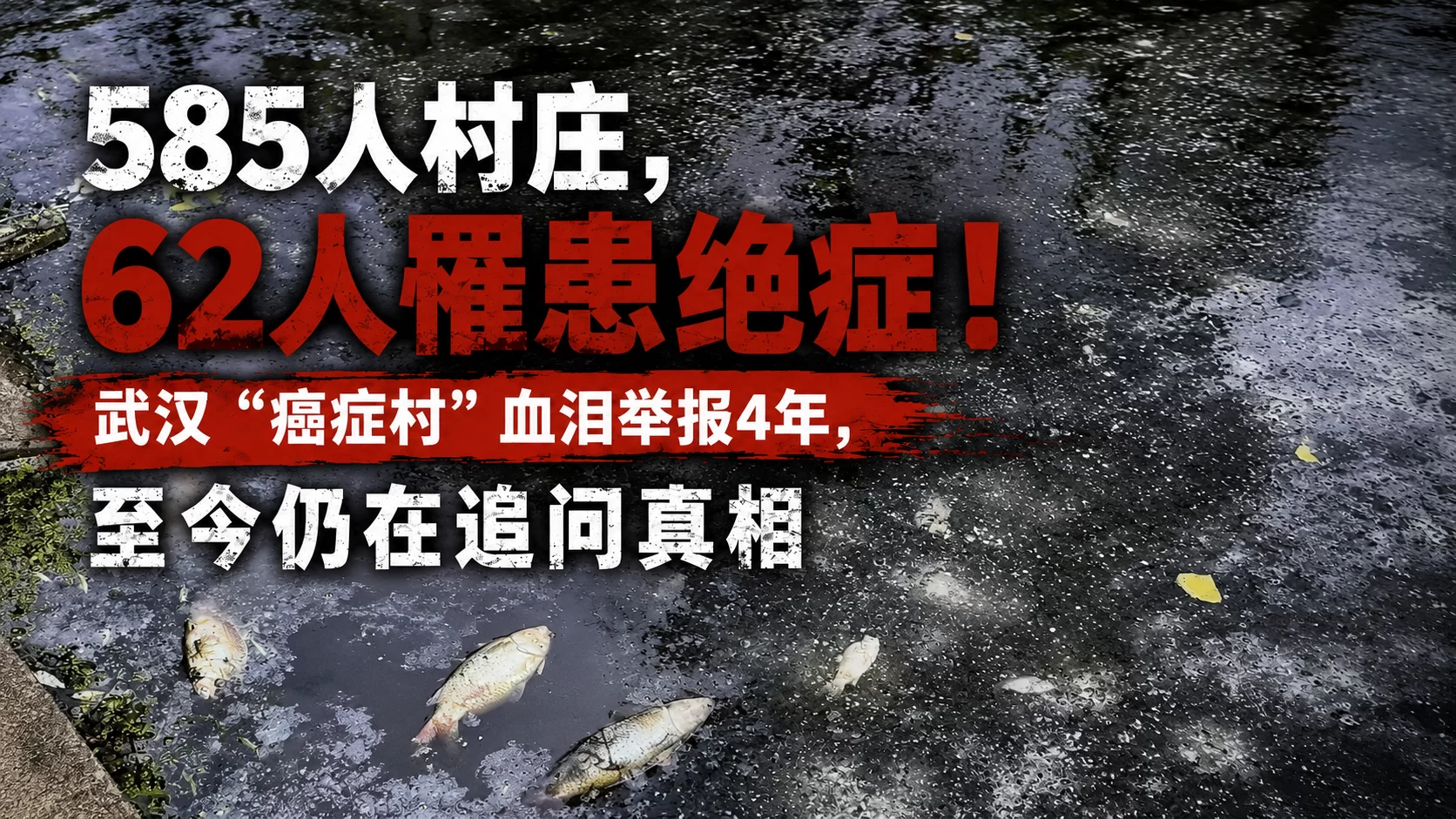
A natural village with a registered population of just 585 has seen 62 people collapse in agonizing suffering from cancer and leukemia. A chemical factory in Wuhan has been illegally discharging pollutants for years, leading local villagers to suspect it is the main culprit behind the illnesses. Yet after four years of tearful reporting and a life-and-death struggle, local environmental authorities continue to cover up the truth and refuse to disclose key enforcement information. Even under supervision by the provincial department, the unscrupulous factory continues to pay lip service while secretly discharging pollutants. This is not only a shocking ecological catastrophe, but also a decades-long “deliberate murder” of ordinary citizens at the bottom of society, enabled by an authoritarian system.
I. Shocking Numbers: A Village of 585, with 62 People Crossing the Threshold of Death
In Huangtupo Natural Village, Zhangxin Village, Liji Subdistrict, Xinzhou District, Wuhan, Hubei Province, the shadow of death has loomed for more than a decade.
- A Concentration of Death: According to incomplete statistics compiled independently by villagers and the village committee, 62 people in the village have developed cancer or leukemia, many of them young and middle-aged adults under 50. Since 2015 alone, 34 villagers have been diagnosed, 19 of whom have already died in agony, while 15 continue to endure torturous treatment.
- Catastrophe for Families: Xu Wenjie’s wife was diagnosed with leukemia in 2012 at the age of 43 and died after four years of treatment. In 2017, his daughter, only 26 years old, was diagnosed with leukemia as well. Two generations of women in the same family were devoured by terminal illness. The enormous debts incurred for medical treatment forced him to travel to Wuhan to make a living driving a taxi. When his daughter was receiving treatment in the hospital, a doctor perceptively asked him, “Is there a chemical factory near your home?”
- The Tip of a Concealed Iceberg: Villagers say the real figure is far higher than 62. In rural areas, many families deliberately conceal illnesses from the village in order to arrange marriages for their children. It is estimated that at least a dozen more patients have not been included in the official statistics.
Contextual Comparison: According to an analysis report released by China’s National Cancer Center, the cancer incidence rate in China is 207.7 per 100,000, while the leukemia incidence rate is approximately 3–5 per 100,000. The incidence rate in Huangtupo Village exceeds the normal range by hundreds of times. This village, which should have been a place where people could live and work in peace, has become a genuine “cancer village.”
II. The Source of the Pollution: An Unlicensed Chemical Factory Inside the “Ecological Red Line”
The villagers unanimously point to the Wuhan Xinzhou District Changsheng Sodium Silicate Factory at the northern end of the village as the culprit behind the illnesses. Founded in 1986, the enterprise was later bought out and converted into a private company. It mainly produces solid sodium silicate (commonly known as water glass), generating large amounts of dust, waste residue, and strongly alkaline wastewater in the production process.
- An Unlicensed “Black-Market Operation”: A later investigation by the Wuhan Municipal Bureau of Ecology and Environment confirmed that the factory had no environmental impact assessment procedures and no pollutant discharge permit whatsoever, making it a thoroughly illegal operation that had been outside regulatory oversight for years.
- Trampling on the Ecological Red Line: The factory openly sits within the basic ecological control line designated by the Wuhan municipal government. Under the applicable Wuhan Regulations on the Management of Basic Ecological Control Lines, construction of chemical factories is strictly prohibited in this area. Yet here, laws and regulations have been rendered meaningless, and the factory continued openly violating the law and producing even when villagers began filing complaints en masse.
III. The Trail of Poison: From the Discharge Ditch to Villagers’ Dinner Tables and Wells
The Changsheng Sodium Silicate Factory is situated on higher ground. Its “soy-sauce-colored” industrial wastewater spreads recklessly down the slope, passing directly through villagers’ vegetable plots and flowing into ponds and underground water systems used for irrigation and daily life.
- Devastating Ecological Damage: A thick layer of blackish-brown hardened crust has accumulated at the bottom of the discharge ditch, and the soil has become so compacted that even hoes cannot break it. Li Xianggui, the owner of a vegetable plot who has been diagnosed with esophageal cancer, complained that when the factory was operating, dust hung in the air like smog and the vegetable leaves were covered in black ash, making them completely inedible. Corn growing near the discharge ditch was reportedly only half as tall as normal corn.
- An Ecological Massacre in Surface Water: In June 2022, photographs taken by villagers showed that the factory’s discharges had turned large stretches of nearby agricultural irrigation ditches black. Dead fish lay in masses, and even a stray cat reportedly died on the spot after mistakenly eating one of them.
- Excess Toxins in Groundwater: Tap water did not reach the village until 2016; before that, villagers had relied on groundwater for generations. Even in 2024, two years after the factory was ordered to halt production, repeated transfers by the central environmental inspection team led to testing by a third-party company that found the manganese content in the well water at Xu Wenjie’s home still reached 0.312 mg/L, a full three times above the limit!
IV. The Arrogance of Official-Business Collusion: The “Protective Umbrella” Role of the Xinzhou District Environmental Sub-Bureau
In the face of villagers’ desperate pleas for their lives, the conduct of the local agency directly responsible for regulation—the Xinzhou District Sub-Bureau of Ecology and Environment—fully exposed the corruption, arrogance, and shamelessness of power at the grassroots level:
- Leaking Information and Helping Destroy Evidence: After villagers filed their first complaint in April 2022, the Xinzhou District Sub-Bureau deliberately dragged its feet. During that time, the factory owner, Xiong Yaoxi, admitted that he had received a call from staff at the district sub-bureau telling him to hurry up and block the discharge outlet and re-dig the discharge ditch to cover up the evidence of wrongdoing. Villagers captured these details on video.
- Choosing the Perfect Time to Falsify Testing Results: On April 25, 2022, staff from the district sub-bureau deliberately went to collect samples from the pond on the day after a heavy rainstorm. By then, the wastewater in the pond had already been washed away and diluted by rainwater, so the test results naturally and absurdly showed that it “met the standards.” They even publicly explained the “soy-sauce-colored” toxic water as “rainwater mixed with tree bark, wood chips, and garbage from the ground.”
- Openly Acting as Lobbyists for the Illegal Enterprise: When a large team from the Wuhan Municipal Bureau of Ecology and Environment came down to conduct enforcement and demanded that the factory immediately halt production, Cao Jing, a staff member of the Xinzhou District Sub-Bureau, actually interrupted on the spot to plead for the company: “There are still a lot of raw materials in the factory. Let them finish production before shutting down.” Another Xinzhou district official even evaded responsibility on camera, saying: “This isn’t the responsibility of the Xinzhou District Environmental Protection Bureau... It’s outside my scope of responsibility and not something we can intervene in.”
- Downplaying Administrative Penalties: In the decision imposing a 200,000-yuan fine that was issued after the municipal bureau intervened and under pressure, the district sub-bureau was vague about the composition of the “hazardous waste,” failed to test for heavy metals and toxic substances, and did not transfer those responsible for suspected environmental pollution crimes to the judicial authorities, attempting to settle the matter with a fine.
V. Undercurrents: Arrogance of Power and a Black Box Forced into Silence
After four full years of villagers’ life-and-death struggle for their rights, they have not received a satisfactory answer. All that has greeted them is deception, concealment, and an administrative black box.
- Publicly Shut Down, Secretly Operating; Paying Lip Service: Local environmental authorities have repeatedly claimed that the factory “voluntarily halted production long ago and has dismantled its equipment.” Yet during the 2025 Spring Festival and again in March 2026, villagers repeatedly entered the factory grounds late at night and captured conclusive evidence showing production lines steaming with heat, key equipment—including the biomass boiler, filter press, and storage tanks—intact, and freshly produced sodium silicate products piled inside. Even after the Hubei Provincial Department of Ecology and Environment issued a supervision letter in March 2026, the Xinzhou District Sub-Bureau continued to deny reality with its eyes open, responding that it had “found no signs of resumed production.”
- Black-Box Operations and Refusal to Disclose Information: On March 19, 2026, villagers lawfully applied for government information disclosure, requesting access to enforcement records and original data. On April 14, the Xinzhou District Environmental Protection Sub-Bureau issued a cold response: “On-site enforcement records,” “investigation and questioning materials,” and “evidence materials from the verification process” all constitute internal development information and will not be disclosed! Even the highly toxic waste alkali residue and sludge were forcibly defined by the authorities as “product components rather than waste,” and the public was categorically denied any information about where they had gone.
VI. The Core Mysteries That Remain Unsolved
As the title suggests, the villagers of Huangtupo Village are still waiting in the darkness for a just answer. The following four core questions remain shrouded in layers of mystery:
- Why has the Changsheng Sodium Silicate Factory been impossible to shut down for so long? Against the backdrop of the country’s vaunted “strictest-ever environmental protection law,” who exactly has been providing an immunity shield for a chemical factory with no permits of any kind operating inside an ecological red-line zone?
- How extensive is its actual pollution of the surrounding environment? Third-party testing once found chemical oxygen demand, soluble silicate, and total alkalinity to be severely above the limits, with chromaticity exceeding the limit by 500 times. Why, then, has the local environmental protection bureau consistently refused to conduct comprehensive and transparent toxicity and heavy-metal testing?
- Does the diatomaceous earth waste residue contain radioactive substances? Villagers learned from multiple sources that substandard diatomaceous earth may contain radioactive substances and cause leukemia. Why, then, have the authorities consistently downplayed the matter and avoided discussing it?
- Is there ultimately a causal relationship between the persistently high incidence of terminal illnesses and the factory? Are the deaths of 62 people really nothing more than a “statistical coincidence”?
Xu Wenjie said painfully: “Our demands are not high. We simply hope that an authoritative expert or department will give us a clear explanation. After all, this concerns the lives of several hundred people in the village.”
Conclusion: A Joint Commentary by China Awakeners—Without Constitutional Government and Human Rights, Everyone Lives in a “Cancer Village”
This is not merely a shocking environmental pollution tragedy, but also a decades-long deliberate murder of ordinary citizens by local vested-interest groups, enabled by an authoritarian system.
The disappearance of 62 living, breathing human beings in Huangtupo Village has torn open the ugliest hand of grassroots governance in China. In China today, the so-called “ecological red line” and “central environmental inspections” amount to nothing more than empty words in the face of local government-business interest groups and officials’ careers. A chemical factory with “neither of the two”—neither permits nor oversight—can continue operating safely amid repeated complaints, publicly stopping production while secretly continuing for years. Environmental officials have even personally acted as informants for the factory and resisted the law on the spot. This fully proves that: in a system lacking an independent judiciary and media oversight, power will inevitably form an alliance with capital and become a meat grinder devouring the lives of ordinary people at the bottom of society.
We must state with anguish: On a land without democratic constitutional government, human rights are merely an extravagant empty phrase.
When ordinary people’s lives and safety suffer systemic violations, they have no fair and independent judiciary to which they can bring a lawsuit—not even a single “government information disclosure” document revealing the toxic substances can be obtained. In a dictatorial bureaucratic system that answers upward rather than downward and lacks the checks of elections, the eyes of power remain fixed only on GDP, political achievements, and rent-seeking interests. Lung cancer, stomach cancer, and leukemia among the people at the bottom are, in their eyes, merely “numbers” that can be casually erased as the cost of development.
The tragedy of Huangtupo Village is a microcosm of the fate of every Chinese citizen. Those poisoned today are villagers in Wuhan; tomorrow, it may be every ordinary Chinese person breathing smog-tainted air, drinking toxic groundwater, and eating chemically contaminated food. As long as the fundamental system in which “power is unchecked” remains unchanged, and as long as the separation of powers, judicial independence, and freedom of the press cannot be achieved, all of China may appear to have open roads leading in every direction, yet everywhere it will become an inescapable “cancer village.”
The awakening of the Chinese people must begin by refusing to become sacrifices to the system! We strongly call for a thorough investigation into the environmental protection scandal in Xinzhou District, Wuhan—not only to deliver justice to the hundreds of lives in Huangtupo Village, but also to awaken hundreds of millions of Chinese citizens: **If we do not overthrow the authoritarian and corrupt totalitarian system, and do not fight for genuine human rights and democracy, we and our children will all become the next victims, collapsing beside a poisoned ditch and waiting in despair for an answer.