This English version may have been machine-generated from the Chinese original and may not convey the original meaning accurately.
【Core Disaster Briefing】
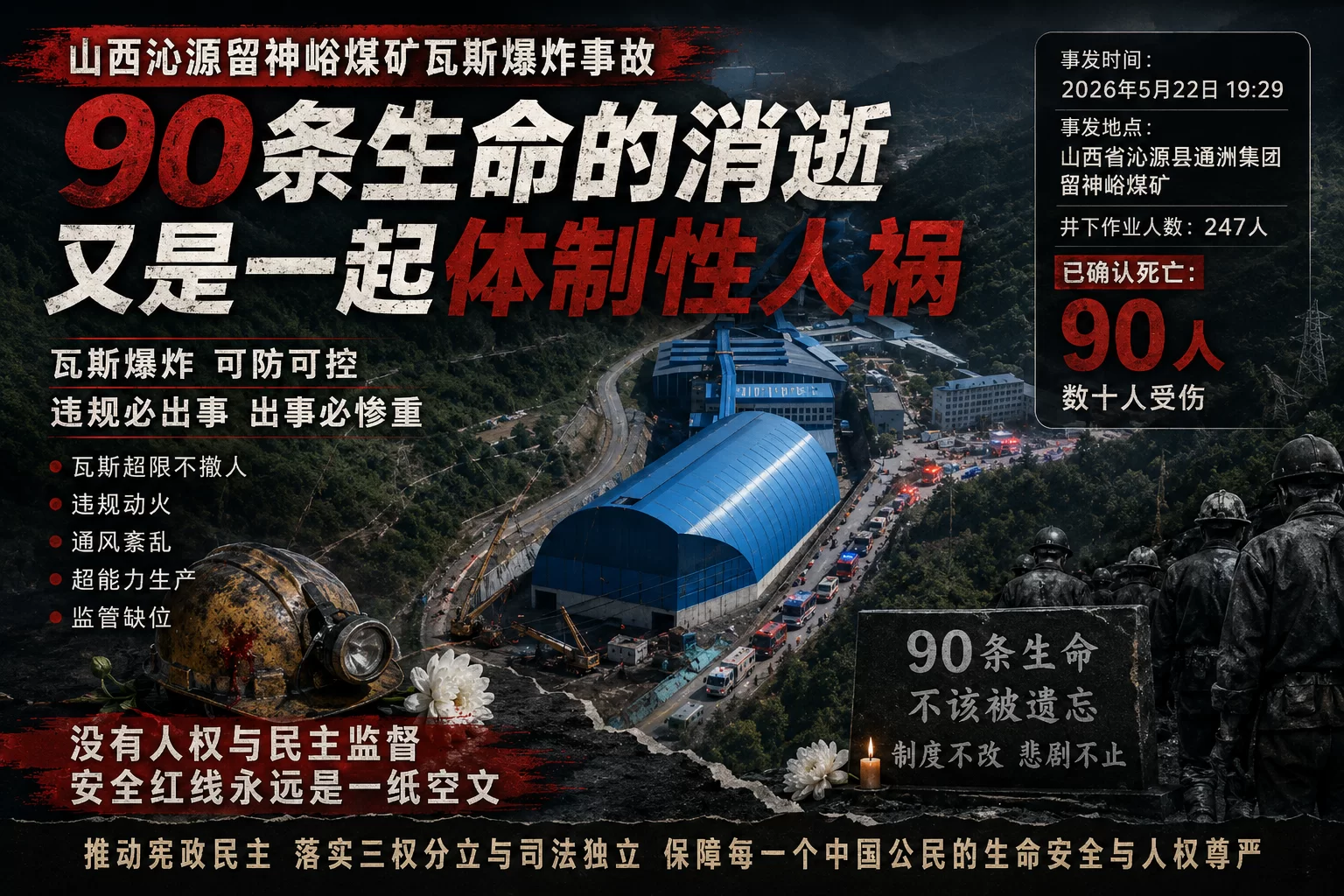
- Time of incident: 19:29 on May 22, 2026
- Location of incident: Liushenyu Coal Mine, Tongzhou Group, Qinyuan County, Shanxi Province (approved production capacity: 1.2 million tonnes per year)
- Latest disaster update: There were 247 people working underground when the accident occurred. According to the latest news as of May 23, 90 deaths have been confirmed, and dozens of people were injured. This is one of the deadliest coal mine safety accidents in China in recent years. The person in charge of the company involved has been taken into custody.
I. A Bloody Record: The Endless Cycle of Similar Tragedies Over the Past 30 Years
Gas explosions have long been known as the “number one killer” in coal mines. Once gas reaches an explosive concentration, it can be ignited instantly by an open flame or electrical spark, producing three deadly hazards: shock waves, toxic gases, and tunnel collapses. The 90 lives lost at Liushenyu Coal Mine are merely the latest entry in the long, bloody record produced by this system:
- 2004: A gas explosion at Chenjiashan Coal Mine in Shaanxi, killing 166 people.
- 2005: A gas explosion at Sunjiawan Coal Mine in Liaoning, killing 214 people.
- 2023: A gas explosion at Xintai Coal Mine in Shaanxi, killing 11 and injuring 11.
- 2025: A gas explosion at Shuijingkeng Coal Mine in Fujian, killing 7 people.
Coal mine safety experts have clearly pointed out that gas explosions are 100% preventable and controllable. As long as four key measures are strictly implemented—ventilation, gas drainage, monitoring and control, and the regulation of open flames—accidents can be prevented at the source. Yet over the past 30 years, more than 80% of the dozens of major gas explosion accidents nationwide have occurred in high-gas mines, with highly consistent underlying causes: failure to evacuate workers when gas levels exceeded limits, unauthorized hot work, chaotic ventilation, and production beyond capacity.
Those safety regulations written in blood and tears are repeatedly ignored in actual operations. This widespread, cross-generational “collective blindness” is by no means merely a technical oversight; it is the inevitable product of systemic callousness.
II. The Fatal Commonalities: Five Visible Violations and the Deeper Dark Secret of “Man-Made Disasters”
As a high-gas mine with an approved annual production capacity of 1.2 million tonnes, Liushenyu Coal Mine ultimately breached the boundaries of safety completely in the course of production, vividly confirming the iron rule that “violations inevitably lead to accidents, and accidents inevitably lead to heavy casualties.” The five obvious problems it exposed all point to systemic collusion behind them:
- Gas control was effectively nonexistent: The high-gas mine failed to conduct gas drainage as required. When concentrations exceeded limits, no alarms were raised and no workers were evacuated, allowing the gas to accumulate until it reached the explosive threshold.
- Unauthorized operations and continuous open flames: Unauthorized electrical welding and gas cutting underground, along with sparks caused by cable explosions, became the fuse that ignited the “powder keg.”
- The ventilation system was chaotic and ineffective: Ventilation doors were improperly left open, airflow was short-circuited, and air supply was insufficient, making it impossible to dilute the gas and causing local concentrations to skyrocket.
- Production exceeded capacity and authorized scope: Mining and excavation areas were concealed, approved production capacity was exceeded, and overloaded operations were conducted amid dense staffing, leaving management completely out of control.
- Regulatory absence and unassigned responsibility: On-site mine supervision was lax, and safety inspections were merely perfunctory. The company prioritized profits over safety, reducing regulations to empty formalities.
The public must see through these technical appearances to the essence: In present-day China, these coal enterprises are GDP incubators that help local officials advance their careers, as well as fiscal cash cows. So-called safety rectification is nothing more than a formality in the face of continuously flowing spoils.
The so-called “production beyond capacity” and “perfunctory regulation” are, in essence, the tacit understanding between local governments and enterprises that they can “have it both ways.” In normal times, officials need companies to produce coal and pay taxes to generate political achievements, so they act as “protective umbrellas,” tacitly allowing them to continue operating despite safety problems. Once the safety defenses completely collapse and tragedy strikes, the bureaucratic system swiftly manipulates public opinion, blaming everything on the company or on microscopic technical details, attempting to use “corporate violations” to wash away the system’s dereliction of duty.
III. 【The Awakened Position】Without Human Rights and Democratic Oversight, the Safety Red Line Will Always Be an Empty Slogan
Miners exchange their sweat for energy and their lives for production. Their safety should not be ignored, much less sacrificed to the interests of the system. The loss of 90 lives at Liushenyu Coal Mine in Shanxi is a heavy warning. It tells us through the starkest possible facts that this was an unequivocal “systemic man-made disaster.”
In a political black box lacking democratic oversight and basic human rights, tragedy is bound to repeat itself endlessly. The roots lie in the following:
- A callous bureaucratic chain accountable only to superiors: Under an authoritarian system, officials’ power is bestowed by their superiors, and their advancement depends entirely on the degree to which they fulfill superior directives and performance targets. They need only answer to those above them and are never required to take responsibility for the safety of the lives and property of people at the bottom. In the eyes of bureaucrats who manipulate figures and pursue political achievements, the lives of miners at the bottom are merely a “social cost” that can be filled in at any time to keep the system running.
- The complete absence of human rights and social oversight: A society without freedom of speech, independent trade unions, judicial independence, or the separation of powers is bound to be ruthless. Workers have no organizations of their own through which to collectively refuse dangerous work, while independent civic oversight and media investigations are subjected to comprehensive suppression. Once society loses all mechanisms for applying the brakes, unconstrained power and capital become intertwined in a frenzy, and the dignity of life at the bottom is completely stripped away.
Conclusion:
As long as this dictatorial system—“accountable only to superiors and depriving people of basic human rights”—remains unchanged, the dark collusion between officials and businesses will continue, and the bloody tragedies suffered by people at the bottom will forever remain merely an annual “list for review.” The awakening of the Chinese people means seeing clearly the essence of this systemic killing. Only by jointly moving China toward constitutional democracy, implementing the separation of powers and judicial independence, and ensuring that power is truly subject to judgment by the people and the law can we end this tragedy of exchanging the lives of people at the bottom for energy, and ensure that every Chinese citizen receives the human rights and life-safety protections they deserve.