
This English version may have been machine-generated from the Chinese original and may not convey the original meaning accurately.
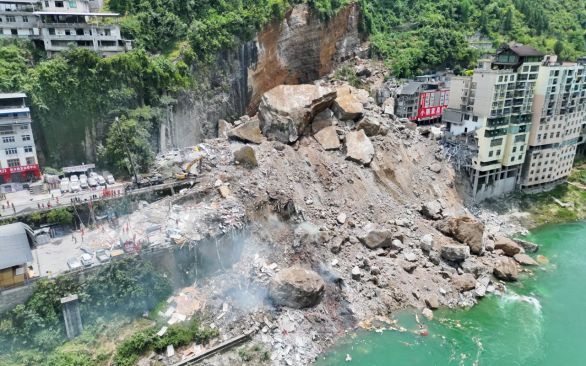
The death toll from the landslide in Pengshui, Chongqing has risen to 41. According to reports, China experiences frequent rain in summer, with floods and landslides recurring almost every year, springing up everywhere. Each time, the official reports are strikingly similar: days of heavy rainfall, complex geological conditions, search and rescue efforts in full swing, and casualty figures constantly being updated. Yet, does this year-after-year narrative of "natural disaster" conceal elements of "man-made calamity" that ought to be scrutinized?
Landslides certainly have natural triggers, but a basic piece of common sense is this: one of the core functions of modern state governance is to minimize foreseeable risks through geological hazard surveys, early warning systems, relocation of dangerous housing and high-risk areas, and emergency response mechanisms. Pengshui is not an isolated case—in recent years, landslides, collapses, and dam breaches have occurred frequently across China, each time accompanied by questions such as "why wasn't the warning issued in time," "why do people still live clustered in dangerous zones," and "did construction projects damage the geological structure." But these questions are often replaced by silence in public discourse once the death toll is announced—because under this system, the very act of questioning is itself dangerous.
This is precisely the core of the problem: in a system where power is unchecked, the press is not free, and the judiciary is not independent, disaster investigations rarely point to those who are truly responsible. Local officials' performance evaluations depend on "stability" and "image," not on transparent accountability; media reporting is constrained by propaganda directives, making independent investigation into the causes of disasters difficult; when affected residents question construction quality, land planning, or delayed rescue efforts, they often face pressure to maintain stability rather than institutional responses. Without an independent judiciary, no one can hold derelict officials or implicated enterprises accountable through legal channels; without press freedom, the public cannot learn whether human negligence, approval violations, or misappropriation of funds lie behind a disaster. As a result, every landslide, every flood, is quietly closed under the label of "natural disaster," while the systemic flaws are never truly fixed.
Imagine if Pengshui had a geological hazard oversight body independent of local government, if the media could investigate and report freely without obstruction, if victims' families could seek truth and compensation through independent courts, if local officials' governance were subject to substantive oversight by elected representatives and the public—might today's 41 lives have been saved through earlier warnings and more responsible governance?
China's disaster narrative often stops at updating the "death toll," without asking "why does this always happen." This is not the result of natural law, but of the power structure: under one-party rule, power need not answer to voters, officials need not bear responsibility for dereliction of duty, and the media dare not press hard for the truth. Only by establishing constitutional democracy, achieving separation of powers, and safeguarding judicial independence and press freedom can every disaster become an opportunity for institutional improvement, rather than yet another forgotten tragedy. The dignity of life should not end as a mere number in an official report, but should be embodied in a system that is truly accountable to the people.
News Background: The original report on which this commentary is based can be found at Deutsche Welle: DW-WORLD.DE.