This English version may have been machine-generated from the Chinese original and may not convey the original meaning accurately.
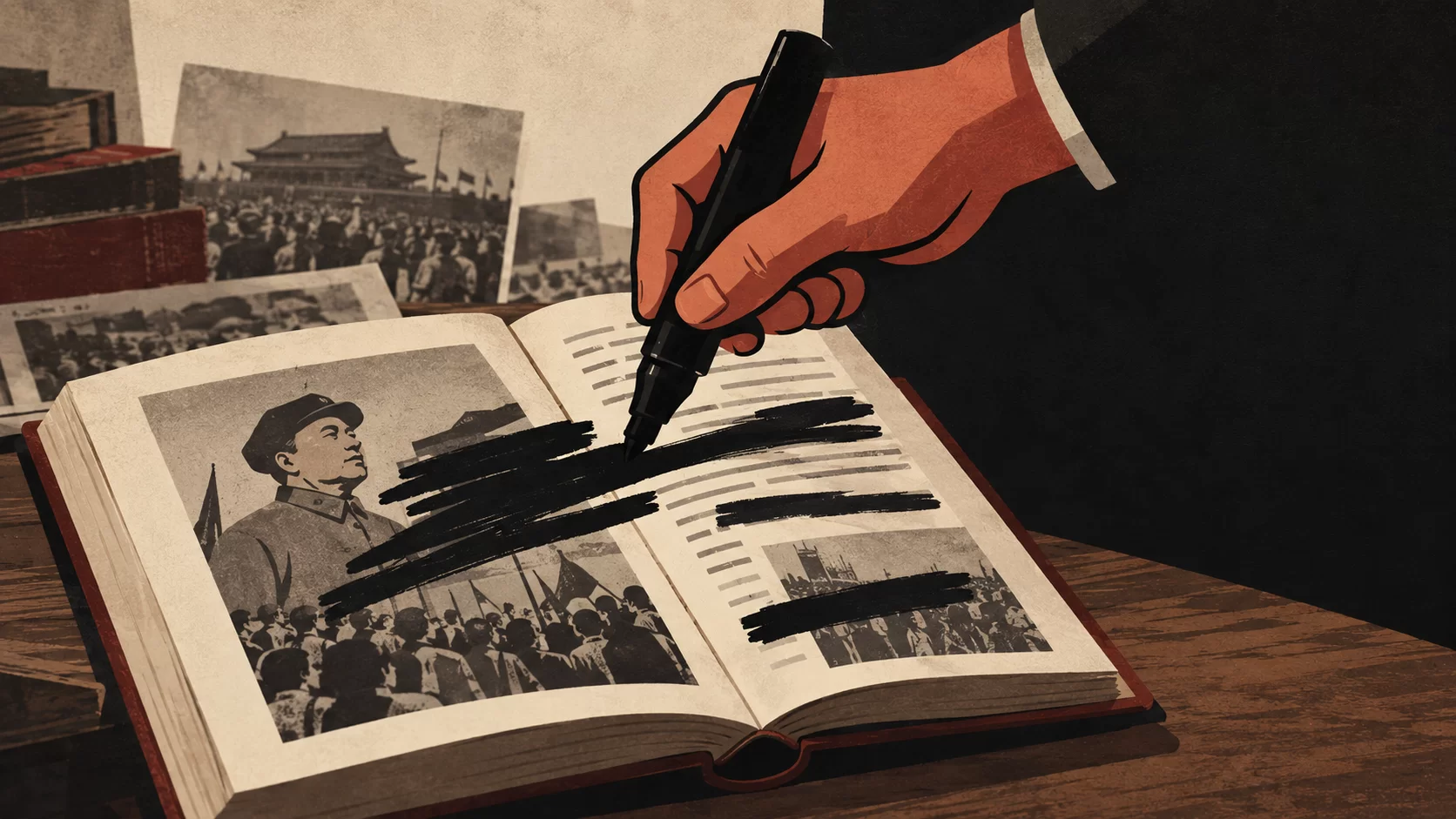
When you ask an AI from a Chinese company about the Cultural Revolution, expecting it to explain that period of history, you may find that it evades the question or even abruptly cuts itself off. A Deutsche Welle report discusses this scene: when AI faces a historical tragedy like the Cultural Revolution, it does not answer like an ordinary information tool, but repeatedly “struggles” between evasion and self-censorship. The report also notes that similar behavior appears in response to more political questions.
What is striking about this is not that the AI gets a fact wrong, but that it may refuse even to take up the question itself.
The Cultural Revolution is not a word that can simply be deleted. It profoundly changed the lives of countless people and became part of the history through which Chinese people understand politics, power, and individual fate. Questions of this kind can be answered with reference to sources, with differing interpretations, and with an acknowledgment of complexity and controversy. But if a machine turns away whenever it encounters certain keywords, what users receive is no longer information, but an invisible wall.
Who built this wall? The AI did not decide to build it on its own. Models do not spontaneously form boundaries around “what can be said and what cannot.” Their manner of responding comes from training, product rules, and management requirements. Yet for ordinary users, it is often unclear who is actually responsible for drawing the line: the company’s review standards, external demands, or a combination of multiple restrictions. When all that remains of an answer is vague evasion, responsibility is hidden along with it.
In the past, the way history was narrated might have been determined by textbooks, news organizations, and publishing censorship. Today, this work has entered the chat window. The difference is that AI looks more like a friend who is always available to ask. You ask it a question, and instead of openly telling you, “That cannot be discussed,” it may steer you away with a smooth, polite response. Over time, people may even mistakenly believe that there was never anything to ask about in this history in the first place.
This is where self-censorship is most effective. It does not necessarily operate through crude prohibition; it can also be accomplished through silence, deflection, and hollow safety-oriented answers. What gets deleted may be more than a single answer. It may also be the habit of asking questions, the courage to pursue them, and the opportunity to connect personal memories with public history.
Of course, AI cannot make historical judgments on behalf of people. It makes mistakes and is constrained by its designers. But a society should at least know why a machine answers in a certain way, who sets its boundaries, and whether users have the right to ask further questions and verify its answers. Otherwise, the more widespread the so-called intelligence becomes, the more easily forgetting can be packaged as a neutral service.
The history of the Cultural Revolution will not disappear simply because a model refuses to answer. What truly demands vigilance is this: when more and more people use AI as an entry point, who has the authority to decide what they can see through that entrance—and what they will never see?
News Background: The original report on which this commentary is based can be found at Deutsche Welle: DW-WORLD.DE。