This English version may have been machine-generated from the Chinese original and may not convey the original meaning accurately.
To judge how much of “one country, two systems” remains in Hong Kong, it is not necessary to begin with political slogans or court rulings.
Sometimes, a more direct question is:
Can Hong Kong residents still freely open a website that Beijing does not like today?
In September 2026, U.S. Senators Tim Kaine and James Lankford introduced the Jimmy Lai Internet Freedom Act, which seeks to support internet freedom in Hong Kong through the U.S. government and the Open Technology Fund, including VPNs, firewall circumvention technology, and digital security tools.
The bill of course cannot directly change Hong Kong’s legal system.
But its very emergence carries symbolic significance:
A global city once known for its open internet and clear differences from mainland China’s online environment has now become the subject of discussions in the U.S. Congress about “how to help local residents circumvent internet censorship.”
This may be more worth observing than simply saying that “one country, two systems is already in name only.”
Because the real change taking place on Hong Kong’s internet did not come in the form of a sudden Great Firewall identical to the mainland’s.
On the contrary, it has taken a more covert form—one that is also easier to overlook.
Hong Kong has not been completely “cut off from the internet”—and that is precisely the problem
Today, Google, YouTube, and a large number of international websites remain accessible in Hong Kong.
Therefore, describing Hong Kong as a place that has completely replicated mainland China’s online environment would be inaccurate and could also weaken our ability to recognize the real changes taking place.
What truly deserves attention is this:
The open internet still exists, but restrictions on political content are taking shape.
According to relevant reports by the U.S. Department of State, internet access in Hong Kong remains broadly open overall, but the National Security Law and related enforcement mechanisms have given the government the power to require internet service providers to restrict access to websites, remove relevant content, and provide user information. The reports also document cases in which certain political and human rights websites were inaccessible in Hong Kong.
Websites affected in recent years include platforms related to Hong Kong democracy, human rights, people in exile, and commemorations of the June 4 crackdown.
In September 2026, the Washington-based Committee for Freedom in Hong Kong Foundation (CFHK) website was also found to be inaccessible through some Hong Kong internet service providers. When questioned, Hong Kong’s Security Bureau neither confirmed nor denied whether the government had ordered the blocking, instead referring reporters to the internet service providers; those providers likewise offered no clear explanation.
This is the most alarming aspect of internet censorship in Hong Kong:
It does not need to shut down the entire internet.
It only needs to make certain websites disappear.
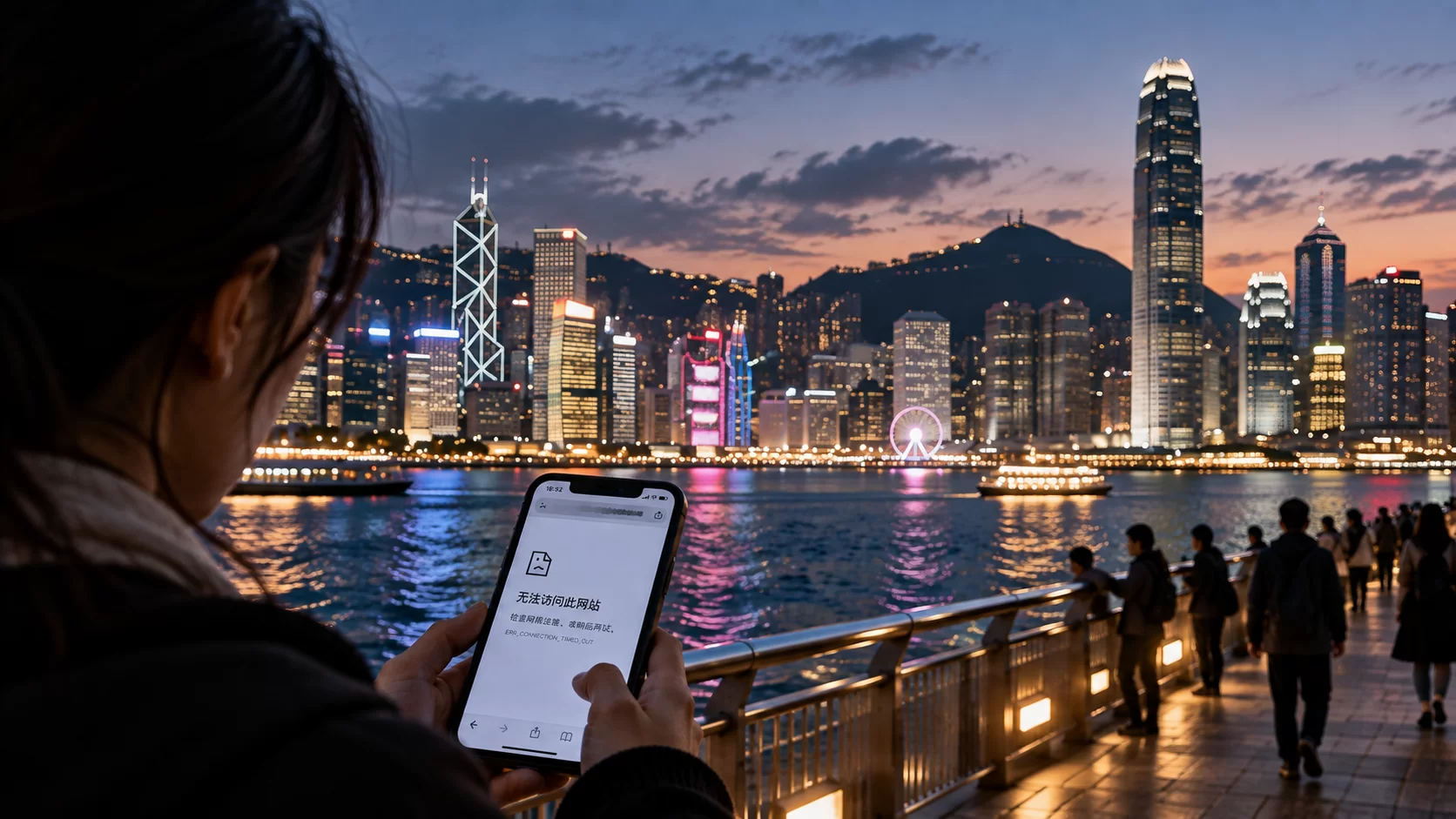
The most dangerous censorship is making people think that a website is simply “not loading”
Traditional news censorship usually leaves clear political traces.
Newspapers are shut down, newsrooms searched, journalists arrested, and assets frozen—the public can clearly see where power has intervened.
Internet blocking is entirely different.
When users open a URL, they may see only:
- The webpage cannot be loaded;
- Connection failed;
- DNS error;
- The server did not respond.
As a result, ordinary people often first think:
“Is the website down?”
“Is there something wrong with the server?”
“Is there something wrong with my network?”
Rather than:
“Was this blocked at the government’s request to internet service providers?”
This is an important shift in censorship in the digital age.
Censorship does not necessarily need to be announced publicly.
Power can produce direct results without necessarily having to publicly bear the political responsibility for the decision.
The Hong Kong government can even avoid explicitly acknowledging, “We are the ones who blocked this website,” while internet service providers can remain silent.
The final result, however, is the same:
The website still exists, the server is still online, and the content is still there—but Hong Kong residents cannot reach it directly.
This is a more covert form of control than traditional suppression.
From “shutting down media” to “controlling access points,” power is moving into infrastructure
When Apple Daily was shut down, the entire process was highly visible.
Police entered the newsroom, assets were frozen, senior executives were arrested, and the newspaper ultimately ceased publication.
This is the form of traditional political repression that the world can see most easily.
But blocking a website does not require such a large-scale law-enforcement spectacle.
The website can continue to exist overseas.
Journalists can continue writing.
Servers can continue operating.
Search engines may even continue to find the relevant pages.
The government only needs to have internet service providers restrict access.
Article 43 of Hong Kong’s National Security Law and its related implementation rules have already established a legal mechanism requiring network service providers to take “prohibitory action,” including restricting or stopping users from accessing relevant platforms or content.
This means the point of control has shifted:
In the past, power primarily entered news organizations; now, it can move further into the infrastructure through which information is disseminated.
The content does not need to be deleted.
It only needs to be made invisible.
And this is where the true danger of internet censorship lies.
“Gradual blocking” is easier to accept than building a firewall overnight
Hong Kong is of course not yet a complete “Great Firewall” in the mainland Chinese sense.
That is precisely why the real question to observe is not the simple question of “whether Hong Kong has a firewall,” but rather:
Which websites are gradually being excluded from Hong Kong residents’ information space?
Existing research has found that internet censorship in Hong Kong is concentrated primarily in categories related to political criticism and the government, rather than being applied evenly across the entire internet.
This pattern has one obvious characteristic:
It does not require announcing all at once that “Hong Kong’s internet system has changed.”
It only needs to keep adding one “exception” after another.
The website of a political organization.
An overseas Hong Kong media outlet.
A platform run by a person in exile.
A June 4 commemoration website.
A research institution critical of the government.
A website deemed to involve national security.
Each instance of blocking may appear to be merely an isolated case.
But when these individual cases continue to accumulate, the result is no longer just that “a few websites cannot be opened.”
An internet that was originally open begins to develop political boundaries.
And as people gradually become accustomed to these boundaries, censorship completes its most important step:
It changes from an administrative act by the government into an everyday habit among ordinary people.
What Beijing may truly want to preserve is Hong Kong’s “economic interface”
To understand Hong Kong’s changes today, it is also necessary to see another reality underlying “one country, two systems.”
For Beijing, Hong Kong still serves important international financial and economic functions.
The internationalization of the renminbi, capital markets, international financing, professional services, and Hong Kong’s ability to connect China with global markets all give it value that other mainland cities cannot fully replace.
Therefore, Beijing has no need to turn Hong Kong into mainland China in every respect.
A more realistic model may be:
Preserve Hong Kong’s economic interface while compressing its political interface.
Allow Hong Kong to remain connected to global capital while gradually stripping it of its function as a space for free information, independent media, and political organizations.
This is a seemingly contradictory but practically logical model of governance.
The question is:
Can economic openness and information openness really remain completely separate over the long term?
The international financial system depends not only on the movement of capital, but also on the flow of information, legal predictability, professional judgment, and trust in institutional boundaries.
If a political website can become inaccessible today on the grounds of “national security,” businesses will naturally think further:
Today it is a political organization that is restricted.
What about tomorrow?
A research institution?
A news database?
An international nongovernmental organization?
A website involving Chinese sanctions, national security, or sensitive commercial investigations?
As the boundaries of “national security” grow ever broader, those truly affected will no longer be limited to political dissidents.
The arrival of the term “circumventing the firewall” in Hong Kong is itself a signal of the times
In the past, when Hong Kong people talked about “circumventing the firewall,” they were usually talking about mainland China.
“Circumventing the firewall” meant leaving the heavily controlled online space of mainland China and entering the global internet.
Today, the situation is beginning to take on a symbolic reversal:
The U.S. Congress has begun discussing how to help Hong Kong residents circumvent internet blockades.
The introduction of the Jimmy Lai Internet Freedom Act does not mean that Hong Kong has fully entered an era of mainland-style internet censorship.
There is no need to exaggerate this point.
But it does at least show one thing:
Hong Kong’s internet freedom is no longer regarded as an established fact requiring no special protection.
The Hong Kong government already has the power under national security laws to require restrictions on internet access; some political and human rights websites have already become inaccessible from Hong Kong; at the same time, the specific decisions and procedures behind these blocks are not always transparent.
That is the core of the problem.
What will “one country, two systems” ultimately leave behind?
The true meaning of “one country, two systems” has never been limited to Hong Kong using the Hong Kong dollar, having an independent financial market, or retaining commercial institutions different from those on the mainland.
Its more important meaning was that Hong Kong once possessed a social and legal environment clearly different from that of the mainland.
That included:
A relatively open information space.
If Hong Kong ultimately retains its position as an international financial center while becoming increasingly unable to access politically sensitive websites;
If news organizations still exist but can no longer freely discuss certain issues;
If overseas websites still exist but require a VPN to access;
If ordinary people gradually learn:
“Don’t look at that website.”
“Don’t search for that term.”
“Don’t talk about that anniversary.”
Then the moment internet freedom truly disappears may not be the day a firewall is built.
It may be when people begin voluntarily adjusting their behavior to adapt to the invisible wall.
Freedom often does not disappear on the day the government announces, “Starting today, there is no freedom.”
It is more likely to happen when:
Something that could still be done yesterday suddenly cannot be done today;
At first, people ask why;
Later, they get used to it;
Eventually, they stop trying altogether.
This is the real danger facing Hong Kong’s internet today.
Because when censorship becomes an everyday habit, the firewall is no longer merely a technical system.
It begins to become a form of social behavior.
And if “one country, two systems” ultimately retains only financial markets, the Hong Kong dollar, and an international business interface, while even an ordinary resident needs to circumvent a blockade to visit a political website, then what exactly has been preserved?
Is it still “one country, two systems”?
Or merely an economic façade beneath “one country”?
This may be the real question for judging how much of “one country, two systems” remains in Hong Kong today.