This English version may have been machine-generated from the Chinese original and may not convey the original meaning accurately.
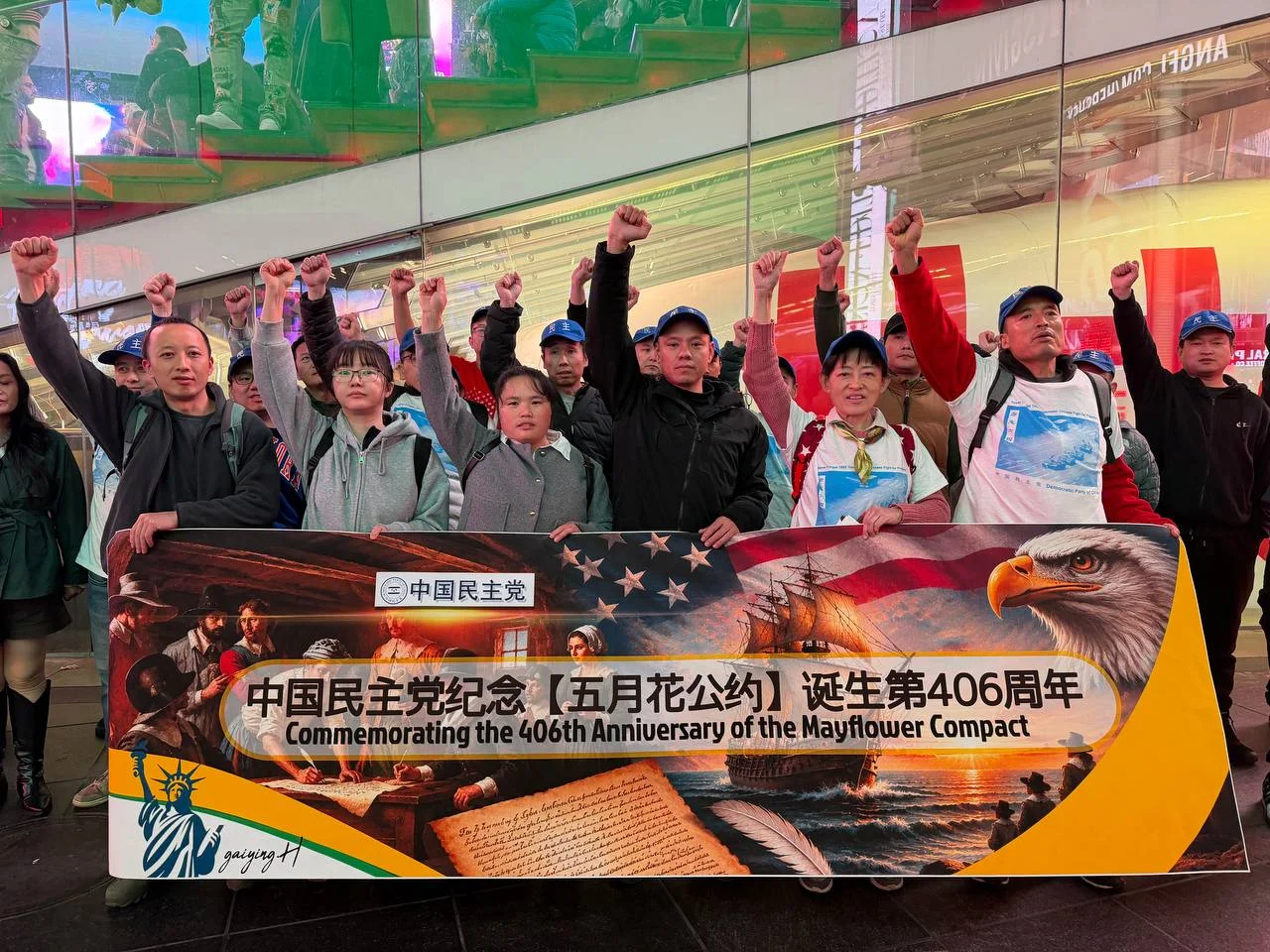
On the evening of November 21, 2026, the China Democracy Party held a special event in New York’s Times Square to commemorate the 406th anniversary of the signing of the Mayflower Compact. A statement by Wang Juntao, chairman of the party’s National Committee, was read aloud at the event, and slogans were repeatedly led calling for an end to one-party rule, the overthrow of the Chinese Communist Party’s tyranny, and the return of power to the people. The statement also announced that the National Committee of the China Democracy Party would hold its Fourth Special Congress this December and proposed the establishment of a Chinese parliament.
Beginning with the Ship’s Cabin in the Atlantic
In his statement, Wang Juntao recalled that in 1620, the Mayflower carried 102 passengers through wind and waves toward the New World. On board were illness, death, and fear, as well as intense disputes; the passengers could not even determine whose commands they should follow after landing. But this group did not allow its differences to destroy their shared future: 41 of the pioneers signed an agreement in the ship’s cabin, deciding to unite and establish a self-governing political community.
The statement said that they did not establish the United States, but they opened a chapter in a history of self-government that the American people would later continually enrich—from the Declaration of Independence and the drafting of the Constitution in Philadelphia to institutional innovations amid successive political crises. Generation after generation of Americans devoted their wisdom, courage, and sacrifices to this cause. The statement also expressed special gratitude to the United States: it was here that democracy advocates from China could freely assemble, organize, and express their ideals under the protection of the Constitution and the law, while learning about democracy and practicing self-government.
At the Event: Slogans and the Statement
The event began with a chant leader calling out slogans, including calls to overthrow the Chinese Communist Party’s tyranny, end one-party dictatorship, bring down dictator Xi Jinping, and put Xi Jinping on trial, as well as “Long live freedom” and “Freedom will prevail.” After the slogans subsided, a speaker addressed the China Democracy Party members in attendance, saying that they had gathered in Times Square that evening to solemnly commemorate the 406th anniversary of the signing of the Mayflower Compact.
According to the speaker’s account, the forebears aboard the Mayflower established a compact in just over 200 Chinese characters, setting out a principle whose general meaning was that the state is not the private property of its rulers. His exact words were:
The state is not the private property of its rulers; the legitimacy of government must never come from violence, lies, or coercive power.
—— Speaker at the event
The speaker went on to say that the legitimacy of government can come only from a compact voluntarily reached and authorization granted by the people. He said that those present had gathered not only to pay tribute to history, but also to proclaim to the world that the Chinese people would never resign themselves to enslavement. He expressed firm opposition to one-party rule, demanded an end to rule by coercive power and the return of power to the people, and advocated that China follow a constitutional democratic path in which power is granted by the people and laws are made by the people.
The statement by Wang Juntao, which was read aloud afterward, first paid tribute to the Mayflower pioneers and the people throughout history who built America’s constitutional democracy, before turning to the work of the China Democracy Party itself. The statement said that this December, the party’s National Committee would hold its Fourth Special Congress to further improve its organizational development, and put forward the following proposal:
We propose establishing a Chinese parliament and exploring a path for the Chinese people to deliberate together, grant democratic authorization, and build constitutional government.
—— Statement by Wang Juntao (Chairman of the National Committee of the China Democracy Party), read aloud at the event
The statement also called for learning from the Mayflower pioneers:
Establish rules amid differences, consolidate strength in exile, and build organizations through struggle, so that the sacrifice of one generation may become the cornerstone of the next.
—— Statement by Wang Juntao (Chairman of the National Committee of the China Democracy Party), read aloud at the event
After the statement was read, the event entered an extended call-and-response slogan session, with the chant leader calling out one line and those present repeating it. The slogans repeatedly focused on freedom, democracy, and human rights, demanding that the Communist Party step down, that Xi Jinping step down, and that Xi Jinping be put on trial, while also calling for the establishment of constitutional democracy and a democratic China. There were also slogans paying tribute to the Mayflower immigrants and the pioneers who founded the United States, as well as chants demanding the release of political prisoners:
Release all political prisoners. Release all political prisoners.
—— Slogan at the event
The slogans in the latter part also included English, calling for a free China, while some participants also shouted “Free Taiwan.”
One Generation’s Sacrifice, the Next Generation’s Cornerstone
According to the statement, the oath made on the Atlantic 406 years ago represented a group of people with differing views learning to establish rules and form a community amid uncertain circumstances. The China Democracy Party chose to hold this event in exile and tell this story to the Chinese people, intending to demonstrate that establishing rules amid differences and building organizations through struggle is the path it plans to follow. The statement concluded by expressing hope that the belief in freedom would unite the Chinese people, that the strength of self-government would be passed down from generation to generation, and that the dawn of constitutional democracy would illuminate China. The Fourth Special Congress in December will be the next step in bringing these words to the organizational level.