This English version may have been machine-generated from the Chinese original and may not convey the original meaning accurately.
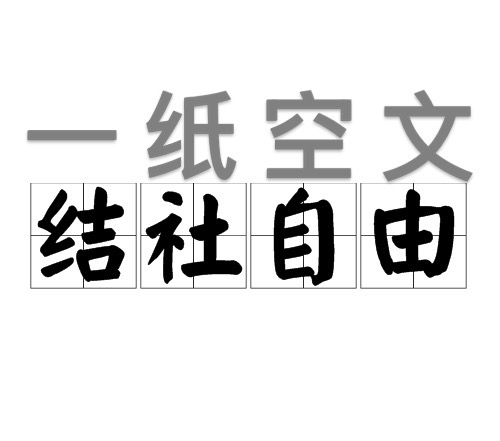
China’s Ministry of Civil Affairs has newly issued the “Measures for the Administration of Branches and Representative Offices of Social Organizations.” On the surface, it is merely a normative administrative document; in reality, it is yet another systematic strangulation of citizens’ freedom of association. The measures require branches of social organizations to “accept the comprehensive leadership of the Chinese Communist Party,” and stipulate that those meeting the relevant conditions must establish Party organizations, while those that do not must also “carry out relevant Party work”—in other words, regardless of an organization’s size or nature, it must ultimately bow to the same center of power. This is not “standardized administration,” but the complete incorporation of freedom of association into the Party’s administrative system.
It is worth noting that, compared with the old measures issued in 2001, the new rules not only continue restrictions on regional and clan-based branches, but also upgrade “not to be registered” to “not to be established,” while for the first time explicitly including provisions on the Party’s comprehensive leadership. The timeline of this change itself deserves scrutiny: why, after civil society had already endured sustained repression since 2014 and independent NGOs had nearly disappeared, does the authorities still insist on tightening the screws? The answer is not complicated—as long as even officially sanctioned social organizations led by people within the system still exist, and as long as these organizations may form connections and linkages across regions and systems, those in power cannot feel secure. Even obedient “white gloves” must be fitted with shorter leashes.
This is the consistent logic of a totalitarian system: what it fears is not some specific organization’s “violation,” but the spontaneous connections among people themselves. Surname-based clan associations, regional groups, and groups with similar names are all prohibited from establishing branches. The reasons may vary, but the substance is singular—to prevent civil society from forming any organizational nodes not directly controlled by the Party. What scholars call the “atomized individual” is no exaggeration, but an accurate description of this mode of governance: society is fragmented into isolated atoms, and any effort to reconnect is treated as a potential political risk.
If freedom of association must be premised on the existence of a Party organization, then the term “social organization” is already a misnomer. Genuine civil society organizations should be independent of any ruling party and represent the spontaneous will and interests of citizens, rather than serving as extensions of organs of power. And under a system of one-party rule, where power is not constrained by voters and the judiciary cannot independently adjudicate the boundaries of administrative power, any claim of “governance according to law” may become nothing more than a fig leaf for the expansion of power—because the party that makes the rules, enforces the rules, and interprets the rules is ultimately the same party, unchecked by any countervailing force.
The root of such problems has never lain in the specific provisions of any one administrative measure, but in the system’s lack of checks and balances within a constitutional framework: there is no judicial system independent of the ruling party to review whether administrative regulations infringe upon the freedom of association protected by the constitution; no representative democratic mechanism through which citizens’ voices can genuinely influence legislation; and no freedom of the press or expression allowing such provisions to undergo public debate before they are introduced. Only by establishing the separation of powers and judicial independence, and safeguarding citizens’ freedom of association, expression, and the press, can “social organizations” truly return to the meaning of the term—spaces for citizens to associate spontaneously, organize themselves, and govern themselves, rather than yet another tightening cord in the network of power.
News background: The original report on which this commentary is based can be found at Radio Free Asia Mandarin.