This English version may have been machine-generated from the Chinese original and may not convey the original meaning accurately.
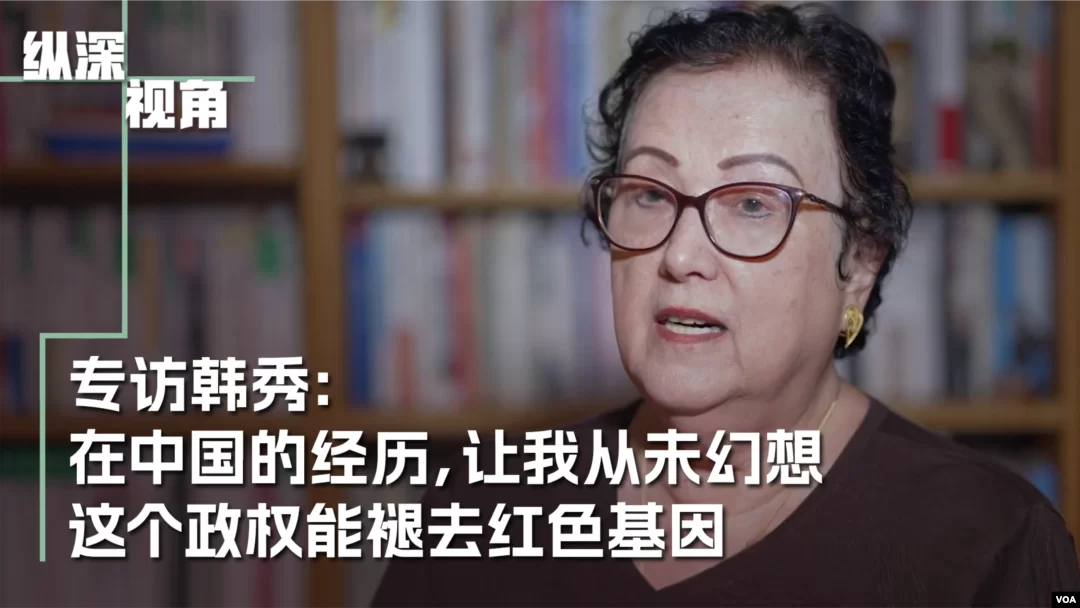
The most intriguing remark in Han Xiu's interview is her comment on the CCP's "biggest mistake"—not abolishing the national title "Republic of China" itself, but instead, through the historical contingency of the two sides of the Taiwan Strait being divided, inadvertently preserving a space for the continuation of Chinese culture. This statement, seemingly casual, actually touches on a fundamental question: why is it that between two regimes inheriting the same cultural tradition, one "destroys whatever it can," while the other manages to preserve 640,000 cultural artifacts and safeguard the creative lives of an entire generation of writers and artists? The answer lies not in culture itself, but in institutions.
Han Xiu, whose birth name is Zhao Yunhui (English: Teresa Hanen Buczacki, born September 19, 1946), is an American Chinese-language writer. Born in Manhattan, New York, she grew up in mainland China from 1948 to 1978.
Three episodes recounted by Han Xiu deserve close reading. The first: in a classroom at the American embassy, beyond mere language instruction, maintaining a space of thought free from surveillance required round-the-clock guarding by Marines—which indirectly reveals that in mainland China, even teaching a few phrases of Chinese or discussing a few plays could fall within the sensitive purview of national security. The second: Gao Xingjian's repeated obstruction in trying to travel abroad—unable to attend a theater festival because he wasn't a member of the Dramatists Association, unable to attend a book fair because he wasn't a member of the Writers Association—a writer's freedom to create and to act entirely subject to the approval of official associations operating through layers of bureaucracy, with individual will carrying no weight whatsoever against the system, until finally the only avenue to freedom left was "staying in France." The third: during the Cultural Revolution, traditional ethics of the sort embodied in "loving fathers and filial sons" were nearly obliterated under extreme political campaigns, with children denouncing parents and spouses turning against each other in struggle sessions—this was not a failure of culture, but rather an unchecked power system systematically destroying all ethical bonds and social relationships that existed independently of the Party.
These three incidents, though seemingly belonging to three separate domains—diplomacy, literature and the arts, and family ethics—share a common root cause: power without checks and balances. Without an independent judiciary to safeguard individual rights at the last resort, without freedom of press and speech allowing different voices to exist, without genuine democratic elections making power accountable, a single association certificate or a single political campaign could be enough to determine whether a person could travel abroad, whether they could write, or whether they could retain the basic dignity of being human. Cultural artifacts can either be cherished or "destroyed whenever possible," and the same holds true for people—it is the institutional system that determines whether they are treated as a foundational asset of the nation deserving protection, or as political tools to be sacrificed at any moment.
The reason Taiwan's experience is worth comparing is not because it is flawless, but because it charted a different path: moving from authoritarianism toward constitutional democracy, judicial independence, and freedom of speech. The fact that the Palace Museum's artifacts suffered "almost no losses" ultimately rests upon a society that gradually established constraints on power. Han Xiu says that a nation's way forward is not merely political slogans, but giving people the opportunity to "see with their own eyes, make their own comparisons, and choose freely." This statement is precisely the most powerful rebuttal to one-party rule—genuine confidence never fears comparison, and never needs to rely on erasing memory or monopolizing truth to sustain itself. Only when constitutional democracy, separation of powers, judicial independence, and basic human rights are genuinely guaranteed can culture and the individual truly be freed from a fate of arbitrary disposal by power.
News background: The original report on which this commentary is based can be found at News - Voice of America.