
This English version may have been machine-generated from the Chinese original and may not convey the original meaning accurately.
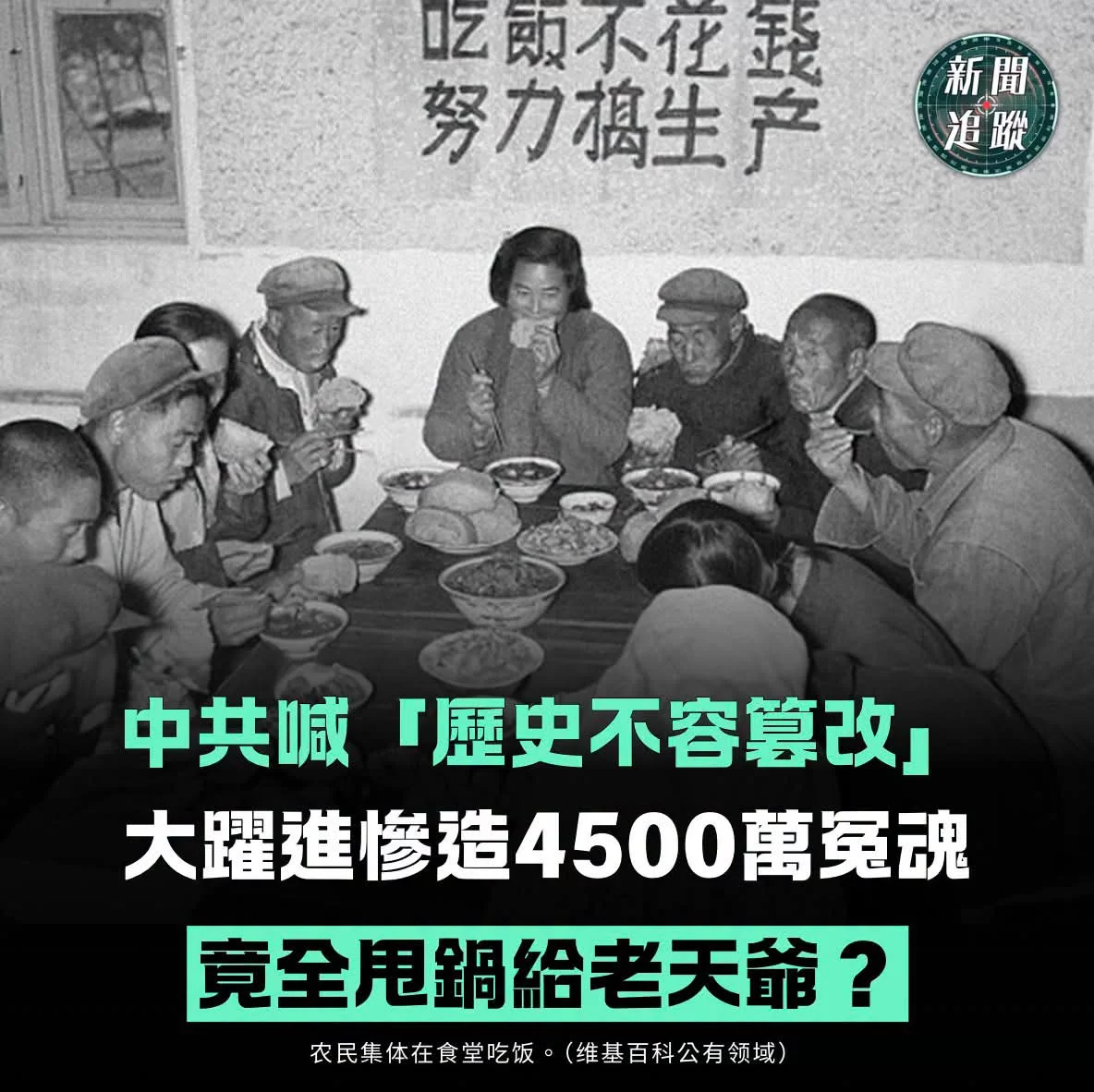
The CCP's official media keeps insisting: "History must not be tampered with." So here's the question — if history truly must not be tampered with, then why, when it comes to one of the most painful man-made disasters in its own ruling history, does it still habitually play it down with vague language to this day?
The "Great Leap Forward," which began in 1958, was accompanied by a series of radical policies including the people's commune movement, exaggerated production reporting, and excessive grain requisitioning. From around 1959 to 1961, China experienced a severe famine that caused a massive number of unnatural deaths.
Regarding the exact death toll, there have long been differing estimates among historians. Yang Jisheng, a former Xinhua News Agency reporter, estimated in Tombstone that about 36 million people died unnatural deaths due to the famine and related policies; historian Frank Dikötter, based on archival and other materials, estimated that the figure could reach as high as approximately 45 million.
Although the numbers vary across different studies, one thing cannot be easily erased:
these were the lives of tens of millions of ordinary Chinese people.
However, for a considerable period, the official narrative has more often used terms such as "the Three Years of Natural Disasters" or "the Three Years of Difficulty." Natural disasters did indeed occur, but if such an enormous loss of life is attributed mainly to "natural calamity," it fails to explain a most basic question: why, when facing the same natural disasters, did different regions and different ways of implementing policy produce such vast disparities?
Even less avoidable is the question of just how much impact the policy errors of that time — the exaggerated production reporting, the people's commune movement, and the grain procurement system, among other institutional factors — actually had on the disaster.
Truly facing history is not meant to stir hatred toward people today, nor to keep the nation forever mired in past tragedy. Quite the opposite — only by daring to face one's mistakes can their repetition be avoided; only by respecting the dead can the living truly be respected.
A society that is genuinely confident should not be afraid of its people knowing their history. Because history is not propaganda material written by those in power for the people to read, but the real memory of lives once lived by countless ordinary people.
If a regime keeps insisting that "history must not be tampered with," then the first thing it should do is not shy away from its own history, not downplay its own responsibility, and certainly not allow the tens of millions of lives lost to be reduced to nothing more than a euphemistic phrase — "a period of difficulty."
History can be temporarily obscured, but it should not be buried forever.
To be responsible to history is to be responsible to those who can no longer speak for themselves.