This English version may have been machine-generated from the Chinese original and may not convey the original meaning accurately.
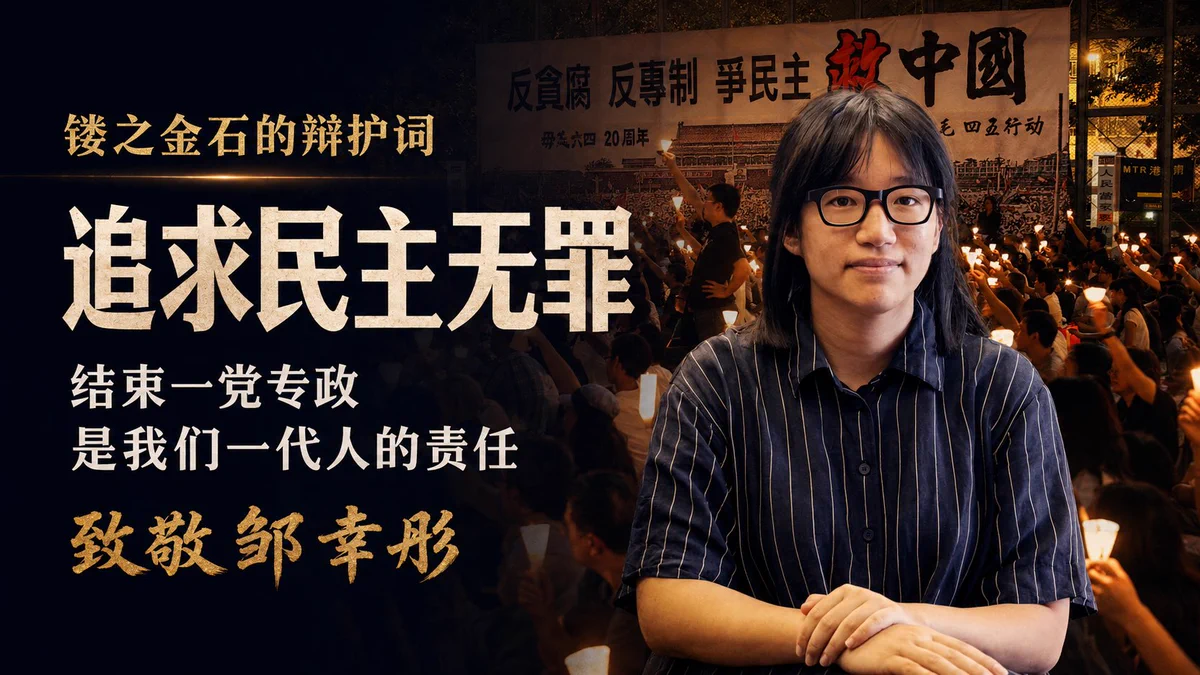
The courtroom pleas by three members of the Hong Kong Alliance in Support of Patriotic Democratic Movements of China appeared on the surface to be part of a sentencing proceeding, but in substance they exposed a more fundamental question: in a system lacking checks and balances on power, is the law ultimately a boundary protecting citizens’ rights, or a tool for preserving political power?
For years, the Alliance has commemorated June Fourth, pursued accountability, and advocated political demands such as “ending one-party rule” through peaceful, nonviolent means. The court’s judgment, however, interpreted this platform as carrying implications of “overthrow” and “subversion,” and on that basis found the relevant conduct in violation of the Hong Kong National Security Law. But if calling for reform of the government system, demanding accountability for historical wrongdoing, and advocating multiparty competition are themselves deemed subversive, then the scope of “national security” can expand without limit, and any critic can be redefined as an enemy.
More worth asking is this: Why can a regime not accommodate remembrance of history, criticism of the ruling party, or even the peaceful political demand to “end one-party rule”? A truly stable system would not regard candlelight, slogans, and memory as forces capable of overthrowing the state. On the contrary, it is only when those in power refuse to make the truth public, reject democratic authorization, and refuse to accept supervision by voters that historical memory and the expression of dissent are treated as threats.
This case also shows that judicial independence cannot remain merely a matter of form. If legal provisions are enacted by those in power, and a case is given symbolic significance under political pressure and the goal of “warning society,” it becomes difficult for the courts to serve as a barrier restraining power. The core of the rule of law is not slogans such as “everyone must obey the law and law enforcement must be strict,” but that the law must constrain the government as well, protect defendants’ rights to freedom of speech, association, assembly, and political expression, and allow judges to independently review state power rather than prove its legitimacy on its behalf.
Chow Hang-tung’s statement that “high walls will only become bigger loudspeakers” is a reminder that imprisonment can restrict a person’s movements, but cannot extinguish a society’s pursuit of dignity, truth, and freedom. Hong Kong’s predicament was not caused by any single slogan, but stems from one-party rule, unchecked power, the lack of genuine electoral competition, and the continual contraction of space for journalism and free expression.
To prevent similar cases from recurring, we cannot rely solely on individual officials becoming enlightened or individual judges showing leniency. The fundamental solution lies in constitutional democracy, the separation of powers, judicial independence, and effective protection of basic human rights. Citizens have the right to peacefully advocate changing the government, and they also have the right to remember those who suffered and seek the truth about history. Such rights are not privileges to commit crimes, but an inherent dignity owed to every person as a citizen.
News background: The original report on which this commentary is based can be found at News - Voice of America.