This English version may have been machine-generated from the Chinese original and may not convey the original meaning accurately.
The Record of Sacred Fear
——Reading American strategist George Friedman's world-famous book The Next 100 Years: A Forecast for the 21st Century
There are several Friedmans in the United States.
In 2009, George Friedman wrote a book entitled The Next 100 Years: A Forecast for the 21st Century. It soon became popular around the world and has remained at the top of the reading list for American citizens. In 2017, Guangdong People's Publishing House translated and published the book.
It is a great pity that I only read it yesterday.
The book's main views on the world over the next hundred years are as follows:
I. The United States will continue to lead the world, and no force can replace it
The Earth has two centers: the land-based center is Europe, and the maritime center is the Pacific, both of which are controlled by the United States. Therefore, America's position as the global hegemon cannot be shaken.
In the new century, there will be three disruptors: Poland, Turkey, and Mexico. Russia, China, Japan, and Europe will all be pushed aside.
II. Muslims will reproduce rapidly, and no part of the Earth will remain at peace
Both Europe and the United States face the danger of Islamization, and China will not be able to remain unaffected.
Because the Xinjiang independence movement will receive funding from international Islamic countries, it will intensify, leaving China exhausted by the effort to deal with it.
III. World War III is unavoidable
Without question, World War III will certainly break out during the first half of the next hundred years, and the victorious side will be the democratic countries of Europe and the United States.
Islam, China, and North Korea will also play leading roles in it, suffering such severe losses that they will be unable to recover.
The countries of European and American Christian culture will be the side that takes up the challenge. Because of Russia's betrayal, the Islamic countries, China, and North Korea can only end in defeat.
After the war breaks out, Russia will side with Europe and the United States, betraying China, North Korea, and the Islamic world.
After all, Russia is a Christian country with an Eastern Orthodox culture. Italy did the same in World War I. Before the war, Italy was allied with Germany and Austria-Hungary, yet when the war broke out, it fought against Germany and Austria-Hungary.
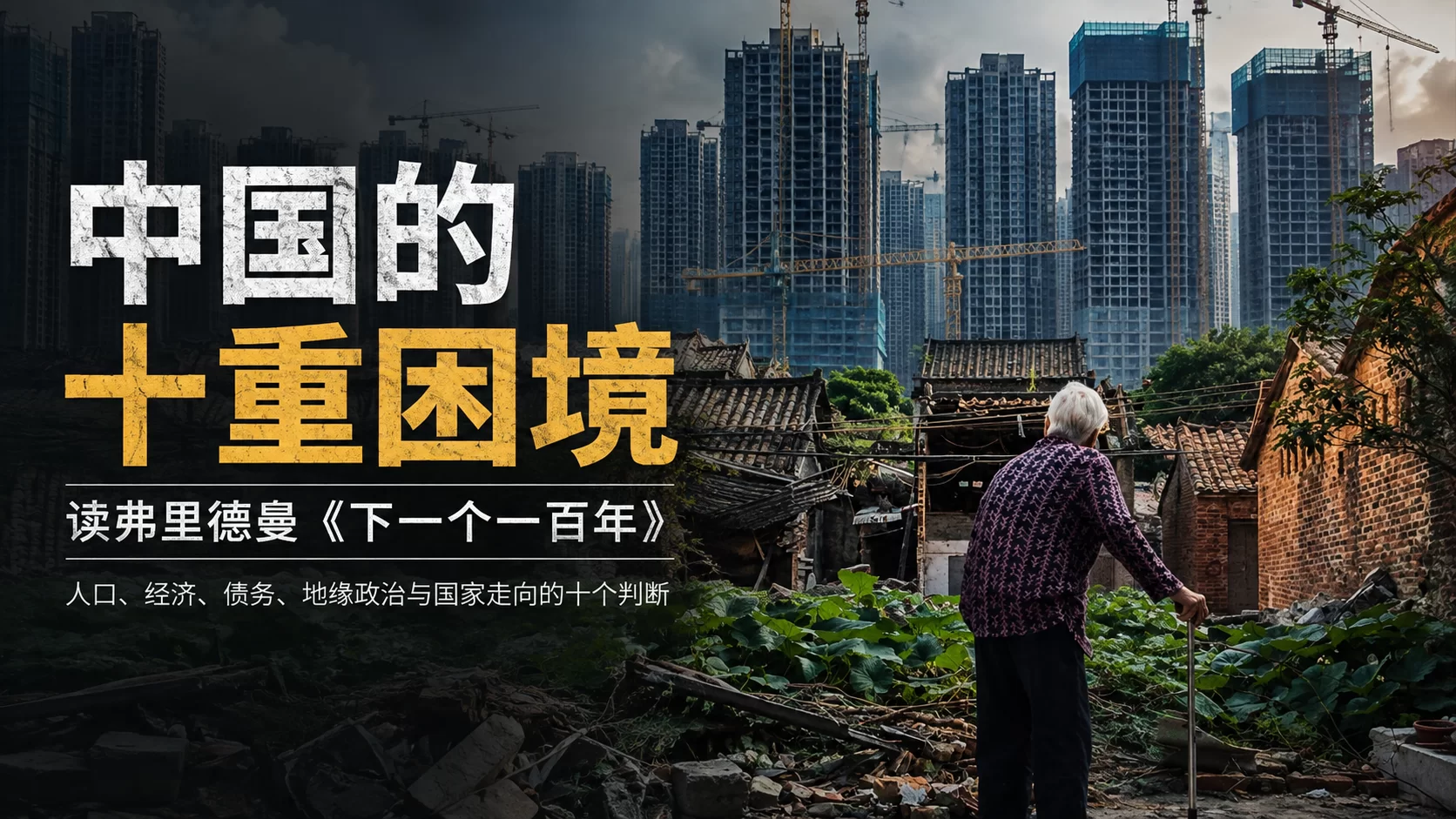
IV. China faces ten major challenges
I mainly read the passages concerning China.
1. Mongolia becomes China's greatest nightmare
Fighter jets taking off from Mongolia could reach Beijing in just one hour, while an armored force could occupy Beijing from land in no more than a week.
The main ethnic group in China is the Han, which emerged during the Han dynasty. Before that, threats from the north had already existed for 1,000 years; they continued afterward as well. In other words, the Mongolian threat to China's national security lasted for 3,000 years.
The only period that truly eliminated this threat was the less than 300 years of the Qing dynasty. The Qing dynasty's methods included religion, intermarriage, and granting royal titles, among others.
From the very first day after the Qing dynasty's collapse, Mongolia began agitating for independence. The entire history of the Republic of China was a history of Mongolian independence supported by Tsarist Russia and the Soviet Union.
However, because of the Republic of China's toughness, Mongolia obtained only a conditional right to hold a “referendum.” The condition was that the Soviet Union remain neutral in China's civil war.
But the Soviet Union did not remain neutral, and Mongolia's independence was legally invalid.
Mongolia's genuine independence came on October 6, 1949, when it established diplomatic relations with the People's Republic of China. The Chinese government acknowledged Mongolia's independence at the legal level for the first time.
Article 1 of the Treaty of Friendship, Alliance, and Mutual Assistance between the People's Republic of China and the Soviet Union of February 14, 1950:
“The Government of the People's Republic of China recognizes the Mongolian People's Republic as an independent state.”
From then on, the greatest threat to China for thousands of years was restored.
Once extreme nationalists (Pan-Russianists) take power in Russia, they will conquer China through Mongolia.
This will be the greatest event in global geopolitics during the new century.
The Chinese government that signed the treaty recognizing Mongolia's independence has no clear understanding of this and therefore faces the danger of national subjugation and genocide.
2. China will return to conservatism
As a traditional continental power, China's lack of active geopolitical fault lines led it to choose isolationism many times throughout history. It was not until the reform and opening-up led by Deng Xiaoping in 1978 that China entered the ranks of world civilization and embarked on a path of rapid development.
However, problems such as the constantly widening gap between the rich and the poor, massive government debt, and weak growth amid structural transformation have filled China's path toward becoming a world power with thorns.
Confronted by encirclement from the United States and Japan and provocations from neighboring countries, whether China in the future can once again amaze the world while resolving its internal problems remains highly uncertain.
In other words, China is very likely to close itself off again, because continuing reform and opening-up would mean that Christian culture would become the mainstream culture and constitutional ideas would take root in the hearts of the people—something China's existing system would absolutely not permit.
Therefore, conservative political forces will rise to power, and China will return to “Chinese characteristics,” or even to the isolationism of the Mao era—that is, to the traditional path of unified rule that China has followed for thousands of years.
China's integration into the world will be forced to come to an abrupt halt.
3. China's inevitable policy direction
China will reject globalization and refuse to continue reform and opening-up, while at the same time burning its bridges and staking everything on becoming the “engine of the world”—that is, establishing a new world order led by China and making the world “Chinese,” just as Islamic countries seek to make the world “Islamic.”
In other words, China rejects globalization but demands the Sinicization of the world.
But, but, but—that is merely wishful thinking on China's part.
China's efforts to make the “world Chinese” will be attacked from all sides by the United States, Europe, Japan, India, Latin American countries, and others.
China will have no choice but to ally itself with Russia, the country that poses its greatest threat.
The Russian people are a nation that will shake hands once and then twist off the other person's finger; China will have to pay an extremely heavy territorial price for this alliance.
4. How can the “Chinese dragon” escape the “Japan trap”?
After its real-estate bubble burst, Japan fell into seemingly endless “stagnation,” known in economics as the “Japan trap.”
China's real-estate sector has expanded excessively. As things stand, the homes built by the Chinese would already be enough to house the entire world's population.
Because of family planning and forced non-childbearing, China's younger generation has been imbued from childhood with a sense of “the original sin of reproduction,” feeling guilt and original sin when having children.
This mindset is not the same as being unable to afford to raise children. In other words, people can afford to raise them, yet choose not to have them.
With no one to carry on the lineage, China's population will rapidly age. The elderly will only vacate homes rather than buy them, so the bursting of the real-estate bubble is foreseeable.
When that happens, banks will fail, industrial chains will break down, and the market will languish. The outlook will be bleak, and falling into the “Japan trap” will be inevitable.
The Chinese government should plan ahead to prevent itself from being unable to move forward when the time comes.
5. The frightening aging population
Within the next 20 years, China will become an aging society. Its neighbor India has a median age 20 years lower than China's.
The number of Chinese people aged 60 and above will reach 30% of the population, or even higher.
This is an event never before seen in human history, and no one knows how to deal with the “silver wave.”
6. The unsolvable wave of unemployment
In order to develop the economy, the Chinese government made real estate a pillar industry and pursued urbanization blindly, causing large numbers of rural residents to flood into the cities.
Cities cannot provide enough jobs, creating a class of displaced people.
Because the government cannot provide high-quality social security, these displaced people have become a source of social instability.
The government has no solution whatsoever.
This is the inevitable result of blind urbanization.
7. Rural collapse
The farmers who have flooded into the cities have nothing to do, while the countryside has become hollowed out by contrast.
The prerequisite for agricultural modernization is private land ownership, which would allow large-scale operations and achieve agricultural modernization. However, this faces constitutional obstacles.
Land privatization in China is impossible. Thus, the vast countryside can only helplessly become desertified and hollowed out.
8. The East-West divide puts China at risk of splitting apart
China's unparalleled manufacturing power is more than sufficient to meet the needs of the entire world.
However, production for the global market is limited to the coast and the Yangtze River basin, drawing the population of the vast interior toward these areas.
More than 80% of China's population will be concentrated on 10% of its land, while the vast national territory will become uninhabited zones, giving foreign invaders an opportunity to exploit.
Russia, India, and Turkey are all watching covetously.
9. The central government will become more authoritarian
Because economically developed regions may show signs of separatism, China will further strengthen centralization in order to consolidate its regime and prevent division.
10. Debt crisis
China's rapid development in recent years has caused its balance sheet to surge.
Borrowing money to develop can certainly generate returns, but borrowing is based on the premise that the money can be “paid back.”
Whether it can ultimately be “paid back” or “cannot be paid back” is not determined by human will; it is affected by multiple uncertain factors.
That is to say, the debtor must have a predictable and stable income—this is the logical prerequisite for debt repayment.
The renminbi's inability to achieve internationalization means that China's balance sheet can circulate only within China and cannot be transferred elsewhere.
This is the main reason China's debt crisis is greater than America's.
No matter how high America's balance sheet rises, Americans can sleep soundly because the dollar is an international currency. Countries compete to purchase U.S. Treasury bonds as investments, and America's balance sheet is thereby broken down and distributed.
China's balance sheet, however, can only be absorbed domestically. This is a terrifying situation.