
This English version may have been machine-generated from the Chinese original and may not convey the original meaning accurately.
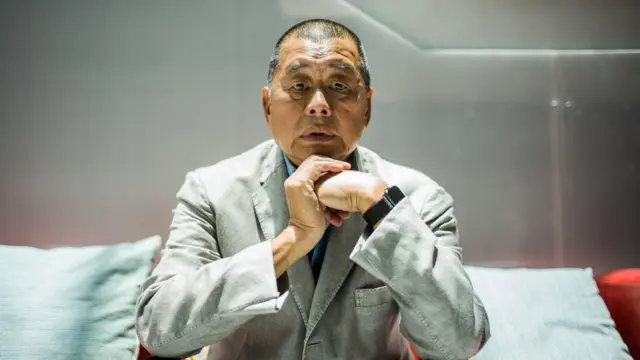
Jimmy Lai: A Man Who Came Out of a Fishing Boat’s Cargo Hold—Why Was He Sentenced to 20 Years?
Jimmy Lai was born into a merchant family in Guangzhou.
After 1949, his family circumstances changed dramatically. His father fled to Hong Kong, while his mother later suffered political persecution. Jimmy Lai lived in poverty during his childhood and once made a living carrying luggage for people at a railway station.
As he later recounted, when he was young, a Hong Kong traveler once gave him a piece of chocolate and told him, “Go to Hong Kong. Everything there tastes this good.”
He never forgot those words.
When he was 12, he hid in the cargo hold of a fishing boat and entered Hong Kong illegally.
At that age, he had nothing and could only start at the very bottom. He worked in a factory in Sham Shui Po, eventually rising from worker to salesperson and manager before starting his own business through his commercial talent.
From a child who fled to Hong Kong, to founding a knitwear business that produced clothing for international brands, and then to establishing Next Media, Next Magazine, and Apple Daily, Jimmy Lai completed a classic rags-to-riches story.
In 1995, Apple Daily was launched.
The newspaper dared to criticize the powerful and openly criticize the Chinese Communist Party, making a tremendous impact on Hong Kong society.
Jimmy Lai later converted to Catholicism and gradually began openly supporting democracy, freedom, and press freedom. He not only expressed his views through the media, but also personally took part in Hong Kong’s social movements.
He was present during the 2014 Umbrella Movement.
He likewise stepped forward during the 2019 anti-extradition bill movement.
In July 2019, he also met with then-U.S. Secretary of State Mike Pompeo in Washington to discuss the situation in Hong Kong and issues including the amendment of the Fugitive Offenders Ordinance. The U.S. State Department publicly confirmed the meeting at the time. 
Some believe that he was “colluding with foreign forces”; others believe that he was using his political influence to fight for Hong Kong’s freedom and democracy.
In December 2025, a Hong Kong court found him guilty on three charges.
On February 9, 2026, 78-year-old Jimmy Lai was sentenced to 20 years in prison, making it one of the harshest sentences in a conviction related to Hong Kong’s national security law. The court determined that the relevant conduct constituted serious offenses and found Jimmy Lai to be the “mastermind and instigator” behind the alleged conspiracy. 
What I find most difficult to come to terms with is not simply how many years an old man was sentenced to.
It is this:
Why did a man who came to Hong Kong at the age of 12 and worked his way up from the very bottom end up at this point in his later years?
Jimmy Lai once said in court:
“I came here when I was 12. Everything I have was given to me by Hong Kong.”
Those words moved me deeply.
He once regarded Hong Kong as his home.
He went from a poor child to an entrepreneur and newspaper founder; he had wealth, and he had fame.
But after choosing to stand by his political convictions, he ultimately lost his freedom.
Some support him, while others oppose him; some believe that he violated national security laws, while others believe that those laws have been used to suppress dissent and press freedom.
But regardless of one’s position, one fact cannot be changed:
78-year-old Jimmy Lai now faces 20 years in prison.
What does 20 years mean for a 78-year-old man?
It is no longer merely a number.
It means that a person’s final years may well be spent behind bars.
I do not know how history will ultimately judge Jimmy Lai.
But I do know that what a society should truly cherish is not merely whether a person has money or status, but rather:
When someone holds views different from yours, do they still have the right to speak?
When a newspaper dares to criticize power, does it still have room to exist?
When an elderly man insists on his beliefs, should he still have his freedom?
Jimmy Lai’s life—from Guangzhou to Hong Kong, from poverty to wealth, from a child laborer in a factory to a newspaper founder, and then to a prisoner today—is itself a life marked by enormous contrasts shaped by the times.
He once fled from the cargo hold of a fishing boat toward the “paradise” in his heart.
And now, he has been locked in a prison cell.
Sometimes the cruelest part of history is not that a person loses their wealth, but that the freedom they once pursued ultimately becomes the very thing for which they pay the highest price.
May history remember this era.
And may the day come when people no longer lose their freedom simply because their views differ.
May everyone be able to speak the thoughts in their heart under the sun.
—Perhaps this is the dignity that a society should truly protect.