
This English version may have been machine-generated from the Chinese original and may not convey the original meaning accurately.
What Happened
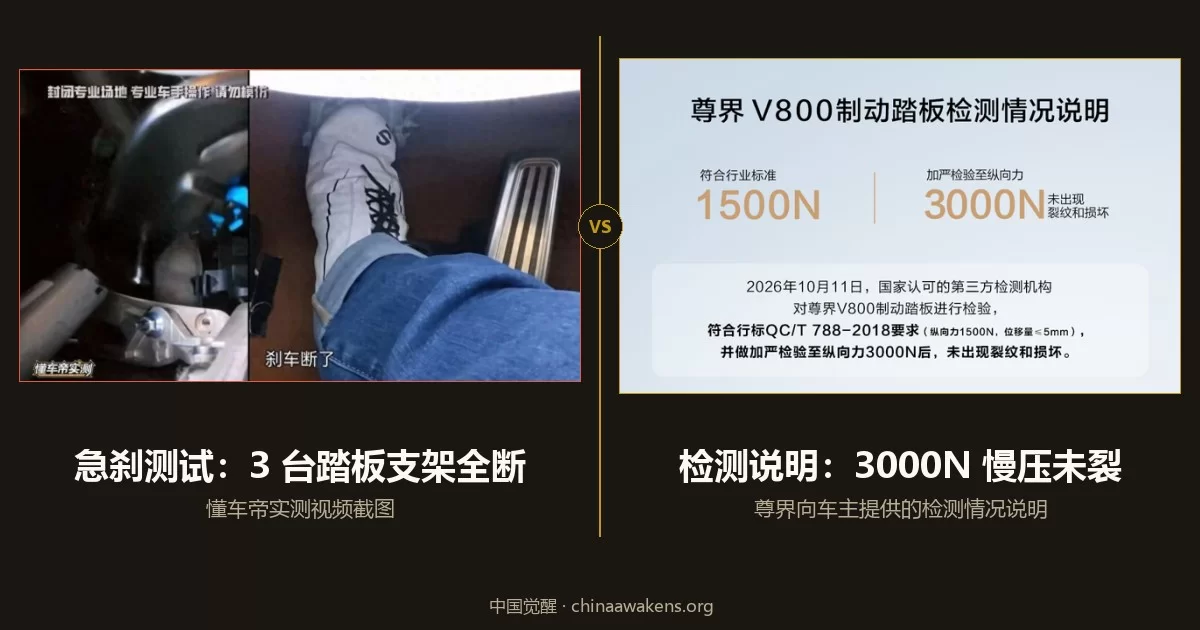
On October 8, the automotive platform Dongchedi released a video of a closed-course test: three brand-new Stelato V800s successively suffered broken brake-pedal brackets during a “100 km/h–0 emergency braking performance test.” The locations and failure patterns were highly consistent. The other eight models tested at the same venue each completed six full-force braking runs without any brake-pedal brackets breaking.
According to reports that were reposted, the first vehicle broke during its third braking run, and the second during its fourth. The third vehicle, newly purchased for verification, broke on its second attempt. At the moment the third vehicle broke, the pedal-force sensor read 1,612 newtons. The testing party said this was close to the boundary of the national standard, which requires the component to withstand 2,000 newtons for five seconds without failing. Sina Auto said the third vehicle’s brake pedal detached completely, causing the braking distance to increase from approximately 38 meters to 140 meters. These figures came from Dongchedi’s testing, which Stelato has not accepted.
The Stelato V800, jointly developed by Huawei and JAC Motors, is a luxury MPV. It went on sale in August 2026, priced from 766,000 yuan to 1.016 million yuan.
How Stelato Responded
On the evening of October 8, Stelato issued a statement saying that the braking system had completed its entire development and validation process according to requirements “higher than national standards and higher than industry standards.” It also said it would optimize the component’s design, provide owners who had already taken delivery with the option of a free upgrade, and conduct a systematic review of design validation, test limits, and production quality management.
On October 13, Stelato provided some owners with a “Statement on the Stelato V800 Brake-Pedal Inspection.” The statement said that on October 11, an inspection by a nationally accredited third-party testing institution found that the vehicle complied with industry standard QC/T 788-2018: a longitudinal force of 1,500 newtons and an average displacement of 2.61 millimeters, below the 5-millimeter limit. The test was then tightened to 3,000 newtons, with a loading speed of 20 millimeters per minute, held for five seconds and repeated five times. A total of 14 brake-pedal component assemblies were inspected, and visual inspection found no cracks or damage.
The HarmonyOS Intelligent Mobility account @AIMIKKKK reposted the statement, saying that the test had been conducted by the China Automotive Engineering Research Institute Testing Center, and disclosed that the circumstances surrounding Dongchedi’s video were “still under investigation.” IT Home said he was an official HarmonyOS Intelligent Mobility staff member, while Kuai Technology described him as an automotive blogger; the two accounts differ.
What Are the Main Questions?
Dongchedi tester Dongmen Jiannan posted a series of messages on Weibo: “Are static loading and dynamic loading the same?” and “There are no sample photos, no video, no before-and-after comparison of the samples, and we don’t even know whether these are the parts currently used on production vehicles.” He also asked: If everything passed, why is an upgrade necessary? Where is the inspection stamp?
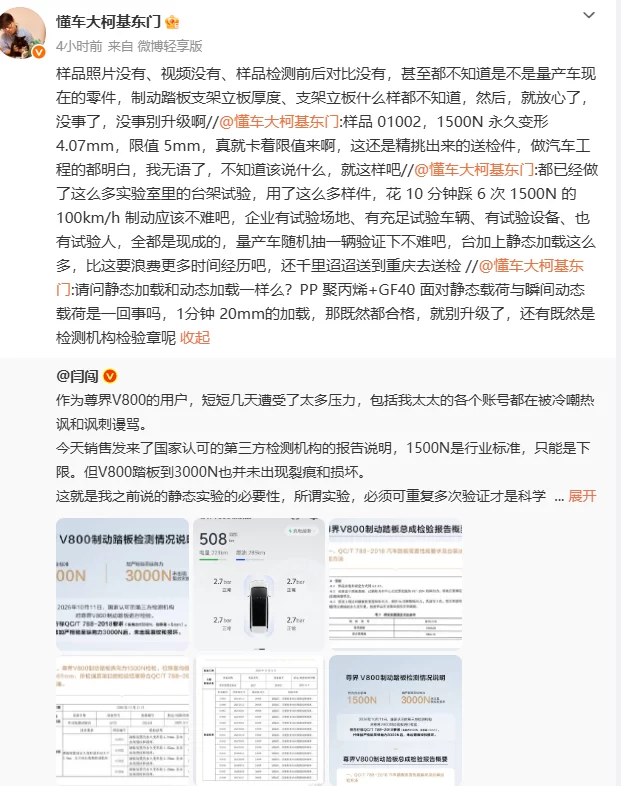
Meng Wei, deputy chief engineer of whole-vehicle products interviewed by The Beijing News, said: “A speed of 20 millimeters per minute is equivalent to about 0.33 millimeters per second. It would be very difficult for an ordinary person to apply the brakes at that speed.” Two engineers said they believed the report was genuine, but thought three questions remained unresolved: whether it simulated the instantaneous impact of emergency braking, whether it reproduced dynamic driving conditions, and whether the test subjects included the brackets that had broken. JAC Motors did not respond to The Beijing News’ repeated requests for comment.
Personnel in the archives office of the China Automotive Technology and Research Center Testing Center confirmed to Yicai that the report existed, while also saying: “Our report is only responsible for the samples or test vehicles submitted by the company. We make no guarantees whatsoever regarding products subsequently manufactured in batches by the company.” JAC insiders confirmed that the statement cited this report.
Li Yanwei, an expert on the Expert Committee of the China Automobile Dealers Association, said this was only a “report summary” and that the complete inspection process could not be verified based on it. There were also reports that the company had “already been deregistered.” An informed source told the 《BUG》 column that this was a registration change involving a judicial appraisal institution, not the cancellation of its inspection and testing business.
How Was This Handled Inside the Firewall?
Of two related topics on Zhihu’s Hot List, one ranked second and the other fourth. They were still present in a snapshot taken at 2:16 a.m. on October 13, but disappeared from both of the next two consecutive snapshots rather than gradually dropping off the list. Zhihu’s Hot List record said they “may have been removed; not independently verified.”
21jingji reported that some users said Huawei phones could not play Dongchedi’s test video, and that under HarmonyOS, all videos in the Dongchedi app sourced from Douyin could not be played. On October 9, Huawei customer service responded that this was an adaptation issue with the latest version of HarmonyOS and that it was communicating with the third-party app.
Apollo News reported that, according to an online rumor, Yu Chengdong said in a Tsinghua alumni association directors’ group in Shenzhen that Dongchedi had exposed the matter because Huawei had not paid it, adding, “The less we pay them, the harder they attack us.” The relevant conversation has yet to be verified, and this site was unable to independently confirm it.
At the official level, People’s Daily said: “A car’s brake pedal should absolutely never ‘break’ while driving!” On October 10, four government departments, including the Ministry of Industry and Information Technology, issued a notice on strengthening the management of innovative design and R&D testing and validation for automotive products (draft for public comment). People’s Daily said industry insiders viewed this as a rejection of “rush-job cars.”
Money and Owners
JAC Motors hit its daily trading limit down on October 8. On October 12, its total market capitalization briefly fell below 50 billion yuan, wiping out more than 10 billion yuan in three days. On the morning of October 13, its share price rose 8.57% to 23.94 yuan. JAC sold 27,201 vehicles in September, down 18.69% year on year.
What Remains Unanswered
While Stelato is offering owners the option of free brake-pedal replacement, it has also produced an inspection statement declaring the components “qualified.” The statement does not say whether the 14 components submitted for testing were production parts or whether they included the type of bracket that had broken. JAC Motors and Stelato did not respond to The Beijing News’ questions on these points, and there is no timetable for when the investigative groups formed by the various parties will announce their conclusions. For owners who are already driving this vehicle, the only thing currently available is this “statement” distributed to only some owners.
Sources (points that could not be independently verified are noted in the text): Sina Finance (archived) · Sina News (archived) · IT Home · IT Home² · Sina News² (archived) · IT Home³ · Sina News³ (archived) · Sina News⁴ (archived) · Sina News⁵ (archived) · Sina Auto (archived) · Apollo News · TG@xhqcankao · TG@xhqcankao² · TG@xhqcankao³ · Sina Finance² (archived)