This English version may have been machine-generated from the Chinese original and may not convey the original meaning accurately.
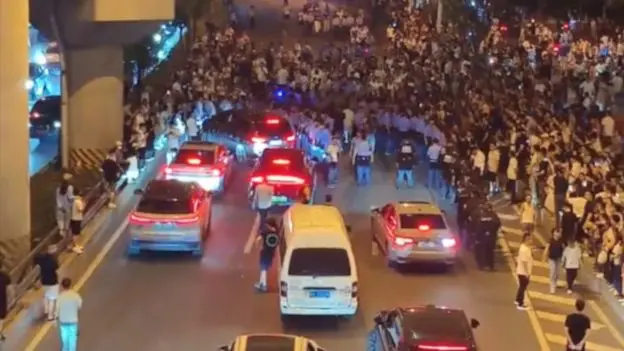
On June 27, more than a thousand residents of Hefei’s Luyang District gathered to protest the proposed site of a garbage transfer station. Local officials eventually arrived and announced that the project had been canceled. Cheers erupted at the scene, while online there was no shortage of praise that “the mass line has finally worked.” Yet if we calmly ask one question—why did residents have to take to the streets and confront the police before the government would “hear” them?—this seemingly satisfactory outcome exposes a deeper institutional malaise.
According to reports, the site-selection plan for the project had previously been announced by the Hefei Municipal Bureau of Natural Resources and Planning, with a daily waste-processing capacity of more than 1,000 tons. In other words, from project initiation to public announcement, the entire process remained a top-down administrative decision, and residents were not granted the right to information or participation during the planning stage. When they discovered that a garbage transfer station was about to be built at their doorstep, the only means available to them was to gather in the streets—the most primitive and riskiest method of all. This in itself shows that under the current system, public decision-making lacks institutionalized channels for public participation: there is no independent hearing mechanism outside the administrative system, nor any judicial remedy to which residents can turn. Their voices can only be seen by those in power if they “make trouble.”
Even more worrying is the arbitrary nature of this “protest–concession” model. In recent years, protests triggered by the not-in-my-backyard effect have been common, involving everything from waste incineration plants to chemical projects and power substations. In most cases, however, authorities have chosen to push projects through or fob residents off with claims of “optimizing construction,” and there have been few precedents like Hefei, where an entire project was canceled on the spot. This vast disparity in how such cases are handled shows precisely that local governments’ decision-making logic is based not on the rule of law and procedural justice, but on temporary calculations of the “cost of maintaining stability.” Only when a protest is large enough, fast enough, and conspicuous enough is it likely to win concessions; by contrast, the demands of dispersed and moderate majorities are often silenced or delayed. This is not a victory for the “mass line,” but yet another display of the arbitrariness of power: today, an order can be rescinded because public opinion is surging; tomorrow, the same project can return once public attention has subsided. The local government has yet to disclose the specific reasons for the cancellation or explain whether the site will be relocated, further confirming the opacity and lack of accountability in the decision-making process.
The root cause of the repeated occurrence of such incidents does not lie in whether a particular official is “enlightened,” but in the lack of checks and balances within the power structure as a whole. One-party rule, with the executive branch above the legislative and judicial branches, means that public affairs such as urban planning and environmental assessments—which should ordinarily be deliberated by elected councils and overseen through judicial review—are in practice decided entirely within the administrative system. There is no independent judiciary capable of hearing residents’ lawsuits against site-selection decisions, no representative body able to reject or revise projects on residents’ behalf, and no news media free to conduct adequate investigations beforehand and create public oversight. As a result, citizens can only use the extreme method of protest to defend their rights once a project has become a fait accompli, or even after construction has begun. That itself is a silent indictment of the absence of the rule of law.
The genuine solution is not to pin one’s hopes on a chance concession by some official following a particular protest, but to establish an institutional framework of constitutional democracy: require public projects to undergo deliberation and a vote by elected representative bodies; make environmental impact assessments public and subject to questioning; allow residents to seek redress through a judicial system independent of the administration when their rights are harmed; and enable news media to report freely and issue early warnings. Only when the separation of powers, judicial independence, and freedom of expression are truly put into practice can citizens’ demands be heard and respected through institutionalized channels, rather than having to gamble each time on whether the government will concede after a confrontation in the streets.
The cancellation of the Hefei garbage station may bring local residents temporary relief, but it cannot conceal one basic fact: under a system in which power is not subject to checks, any “victory” is accidental, revocable, and impossible to replicate. What citizens truly need is not one stroke of luck in the form of a concession, but a constitutional order capable of safeguarding their dignity and rights over the long term.
News background: The original report on which this commentary is based can be found at Radio Free Asia Mandarin